Build Distributed Systems That AI Agents Can Actually Understand
/TABLE OF CONTENTS
/ARTICLE
/ARTICLE
[1]TL;DR
- A distributed system consists of multiple independent services communicating over a network to perform a single job, and network calls can fail in ways that in-process function calls never do. That basic shift is the foundation on which everything else in this piece builds.
- Multi-step task success compounds: if each step in a workflow succeeds with probability p, then an n-step task succeeds end-to-end with probability roughly p^n. At 95% per-step reliability, a 10-step agent workflow still only completes cleanly about 60% of the time.
- Independent evaluations back this up. A CMU and Salesforce study put multi-step agent completion in the 30–35% range, and Sierra's tau-bench, built to test agents on realistic conversational tasks, found every model it evaluated fell short of 50% average success across the domains tested. The problem isn't reasoning; it's what the agent has to read, infer, and re-infer at every hop of a distributed call chain.
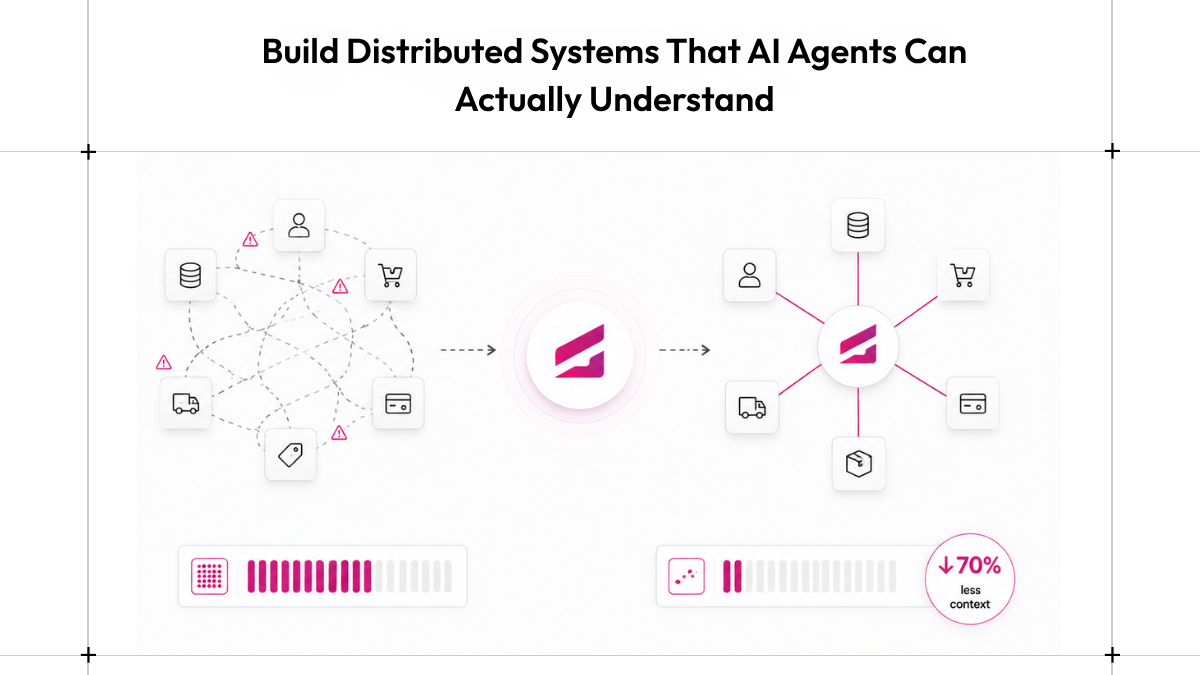
- A distributed system that's legible to an agent has typed, minimal callable surfaces and deterministic failure signals it can act on mid-workflow. The same properties make a system maintainable for humans, just with a lower error tolerance per step.
- Graftcode reduces the hand-written integration code between services with strongly typed Grafts, which shrinks the surface an agent has to read per hop and gives it a compile-time or package-update signal instead of a runtime failure discovered three steps into a workflow.
Most discussions of AI agents in production focus on the model: which one reasons best, which one hallucinates least, which benchmark score is highest. That's the wrong layer to focus on if the agent's job is to operate across a distributed system, call one service, use its output to call another, make a decision, call a third. In that setting, the model's reasoning quality is necessary but not sufficient. What actually determines whether the workflow succeeds is how accurately the agent understands each service it touches, and how quickly it detects when that understanding is wrong.
This guide starts with the basics: what a distributed system actually is and why it behaves differently from a single application, before getting into what specifically breaks when an AI agent, not a human, is the one making the calls, and how to design and build systems that hold up under that use case.
[2]What Are Distributed Systems
A distributed system is a collection of independent processes, usually called services, that run on separate machines or containers, communicate over a network, and coordinate to perform a single task. An e-commerce platform might be split into a catalog service, an inventory service, a payments service, and an order service, each running independently and owning its own piece of the problem.
This is different from a monolith, where all of that logic runs in a single process. In a monolith, one module calls another through a function call: fast, synchronous, and if something goes wrong, the stack trace tells you exactly where. In a distributed system, that same interaction crosses a network boundary, and everything that can go wrong with a network call now applies: timeouts, dropped connections, partial responses, one slow service blocking everything waiting on it.
Teams build distributed systems anyway because the tradeoffs, done well, are worth it:
| Features | Monolith | Distributed system |
|---|---|---|
| Deployment | Single unit | Independent per service |
| Scaling | Scale everything together | Scale each service independently |
| Failure blast radius | One bug can take down everything | A single service failing doesn't have to take down the rest |
| Team ownership | Shared codebase, more coordination | Each team can own and ship its own service |
| Communication | In-process function calls | Network calls, with all their failure modes |
The core trade-off: a monolith fails as a single unit and succeeds as one. A distributed system can fail partially, and that partial-failure property is exactly the thing that makes distributed systems both more resilient and much harder to reason about, for a human or otherwise.
[3]Why Distributed Systems Are Especially Hard for AI Agents to Operate Within
Everything above is true whether a human or a machine is calling those services. What changes with an AI agent is who's making the decision when something looks slightly off.
When a human engineer calls a service and receives an unexpected data shape, they pause. They check the docs, ask a teammate, look at the logs. An AI agent orchestrating a multi-step workflow across services doesn't have that instinct built in by default; it infers what the response means from whatever context it has, proceeds to the next step, and if that inference was wrong, the error doesn't surface immediately. It surfaces two or three calls later, once the bad assumption has already propagated into a decision, a database write, or a message sent to a customer.
This compounds mathematically, not just anecdotally. If each step in a workflow succeeds independently with probability p, the probability that an n-step task completes correctly end-to-end is roughly p^n. At a 95% per-step success rate, already a strong result, a 10-step workflow only succeeds end-to-end about 60% of the time. At 85% per step, a 10-step workflow drops to roughly 20%. Independent evaluations land in the same range. A CMU and Salesforce study put multi-step agent completion at 30–35%. Sierra's tau-bench, built to test agents on realistic conversational tasks, found every one of the 12 models it evaluated fell short of 50% average success across both domains tested.
None of this is really about the model failing to reason. It's about what the model has to infer at every single hop across a distributed system, and how much room there is for that inference to be subtly, silently wrong before anything catches it.
This is a different problem from AI coding agents that read and edit a codebase before anything ships. Here, the agent is operating the distributed system live, the calls it makes have real side effects, and no human is reviewing the diff before it executes.
[4]What Makes a Service Legible to an Agent at Runtime
"Legible" here means: can the agent accurately understand what a service does and what it returns, without having to guess?
Three properties determine this:
A typed, minimal callable surface. A service exposing a REST API with an OpenAPI spec provides an agent with endpoint paths, HTTP verbs, request schemas, response schemas, and error schemas to parse, most of which describe the transport layer rather than what the service actually does. A typed method signature communicates the same callable surface in a fraction of the space, with less room for the agent to misread the data shape.
Semantic accuracy, not inferred behavior. When an agent reads POST /api/v1/process with a JSON body, it infers the endpoint's behavior from naming conventions and any available documentation. A method like OrderService.confirmPayment(orderId, amount) states its behavior directly. The gap between "the interface says what it does" and "the agent has to guess what it does from how it's called" is exactly where compounding errors start.
Deterministic failure signals. When a downstream service's contract changes, a field gets renamed, a return type shifts, an agent needs a signal it can act on. In an untyped REST call, that signal often doesn't exist until the workflow has already failed at runtime, several steps past where the actual mismatch happened. A typed contract that fails immediately, at the point of mismatch, is a fundamentally different debugging experience for an agent mid-workflow than a KeyError surfacing two hops later.
[5]Where Agent-Orchestrated Workflows Break Down in Practice
Consider an agent orchestrating a straightforward e-commerce workflow: check inventory, reserve stock, process payment, confirm the order. In a REST-based system, each hop looks something like this:
# Agent orchestrating a multi-step workflow over REST, no typed contractsimport requestsdef reserve_and_confirm(order_id: str, sku: str, quantity: int, amount: float):# Step 1: check inventoryinv_response = requests.get(f"http://inventory-service:8080/api/v1/stock/{sku}")stock = inv_response.json()# Step 2: reserve stock; the agent infers the request shape from the last responsereserve_response = requests.post("http://inventory-service:8080/api/v1/reserve",json={"sku": sku, "qty": quantity, "orderId": order_id})reservation = reserve_response.json()# Step 3: process payment, a different service, a different response shapepayment_response = requests.post("http://payment-service:8080/api/v1/charge",json={"orderId": order_id, "amount": amount})charge = payment_response.json()# If payment-service renames "amount" to "amountCents" on its side, this request# either gets rejected by validation or has the field silently ignored,# with no signal to the agent that anything is wrong until the workflow fails laterreturn charge
Three things happen here that don't happen with a single API call:
Errors compound across hops. If the inventory service's response shape differs slightly from what the agent expected in Step 1, that misreading propagates into how it constructs the request in Step 2. By Step 3, the agent may be operating on an assumption that was wrong three steps ago.
Schema drift is invisible until the workflow fails. Nothing in this code tells the agent, in advance, that payment-service expects amountCents instead of amount. The agent only finds out when the call fails or, worse, when it silently succeeds with the wrong value because the service ignored an unrecognized field rather than rejecting it.
There's no compile-time signal for a dynamically stitched call chain. The agent constructed this request based on inference rather than an enforced contract. Nothing stops it from generating a plausible-looking call that's actually wrong.
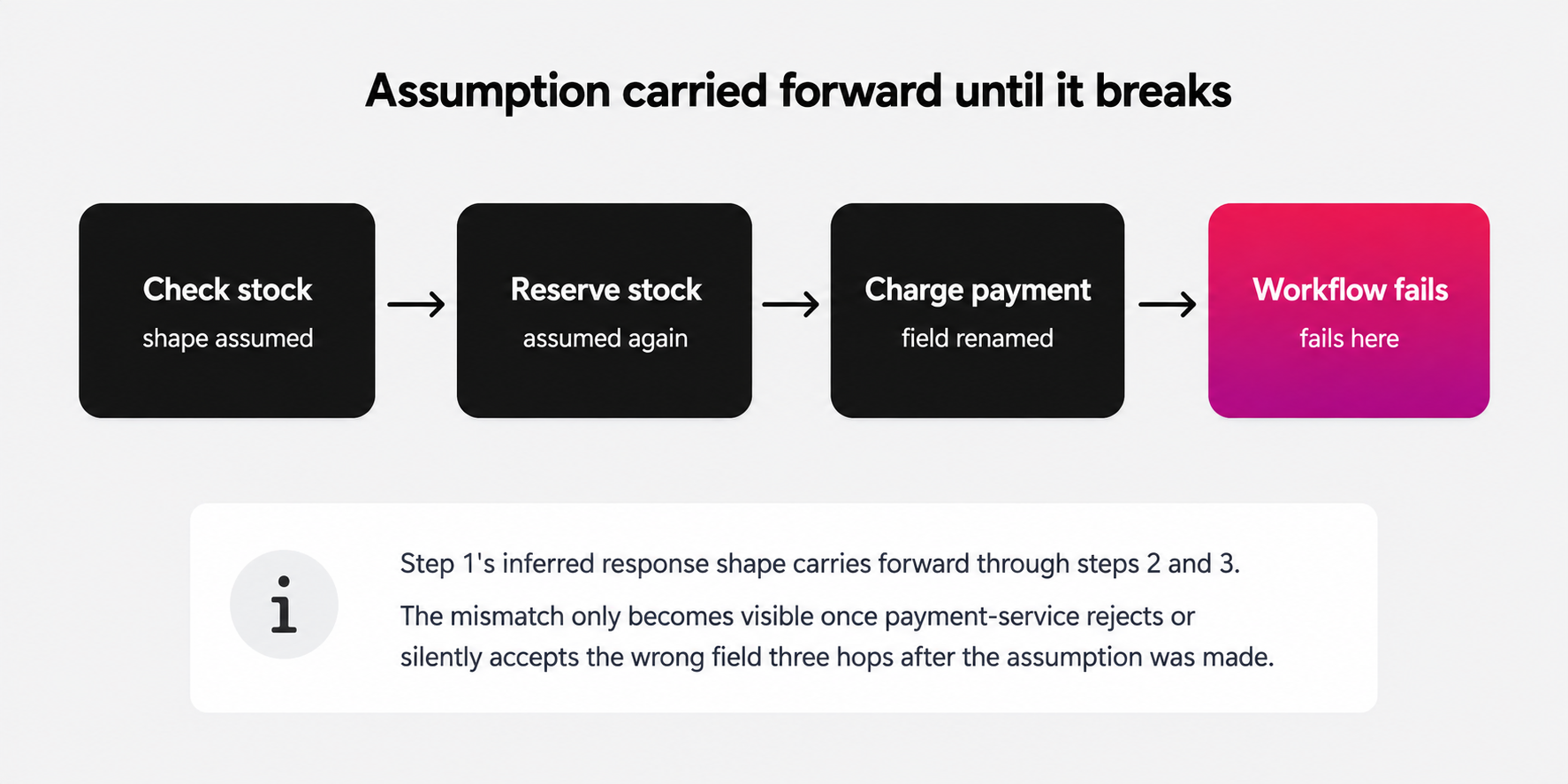
The mismatch traces back to the inferred response shape in Step 1. Still, nothing in the workflow signals a problem until the payment call, three hops later, after the agent has already committed to reserving stock and constructing a request based on that original assumption.
[6]Designing Distributed Systems for Agent Orchestration
Some architectural properties matter more for agent-orchestrated systems than for purely human-operated ones because tolerance for incorrect inferences is lower and the feedback loop is longer.
| Property | Agent-hostile | Agent-friendly |
|---|---|---|
| Interface | Wide REST surface, OpenAPI spec to parse | Narrow, typed method signature |
| Failure signal | Runtime error, several hops later | Immediate, at the point of mismatch |
| Idempotency | Retrying a call risks duplicate side effects | Safe to retry without re-triggering the action |
| Side-effect visibility | Agent can't tell if a call already succeeded | Clear response state the agent can check before retrying |
| Blast radius per call | One bad call can cascade into unrelated services | Each call is scoped and contained |
Idempotency matters more with agents than with humans. A human who's unsure whether a payment call succeeded will usually pause and check before retrying. An agent, in the absence of explicit guardrails, may retry automatically, and if the underlying operation isn't idempotent, that retry can duplicate a charge or shipment. Designing services so a repeated call with the same parameters produces the same result, rather than a new side effect, removes an entire class of agent-caused incidents.
Bounded blast radius keeps a bad inference from cascading. If a service's boundary is drawn correctly, it owns its data, its logic, and its interface completely; a wrong call to it fails in isolation rather than corrupting state in three other services that happened to share a database or an implicit contract with it.
[7]How Graftcode Reduces the Orchestration Surface for Agents
Graftcode is a cross-runtime communication layer. Services call each other's public methods directly through automatically generated interfaces called Grafts, installed as typed packages via standard package managers, without hand-written integration code, DTOs, client libraries, or serialization boilerplate.
Graftcode Gateway runs the provider service itself; it spins up a runtime for the configured modules and exposes their public methods automatically once the service is hosted. Developers can narrow that surface with access policies, allowing or disabling specific classes, methods, or properties, but nothing needs to be explicitly configured just to expose a module's public interface. It is not positioned between services and does not route calls; it exposes an interface.
# Run the Gateway, which hosts the inventory service./gg --projectKey <your-project-key> --modules ./inventory_service.py
The Gateway serves calls on port 80 and Graftcode Vision, live documentation of every exposed method, on port 81, by default. It also exposes a Model Context Protocol (MCP) endpoint automatically for every hosted service, so an AI agent can call it directly without an installed Graft or any additional setup.
Graft is a strongly typed interface, installed via a package manager, that mirrors the provider's public methods exactly: names, argument types, return types. Graftcode supports 20 programming languages across 10 package managers.
npm install --registry https://grft.dev/<project-id>__free @graft/nuget-inventoryservice@1.0.0
GraftConfig is an internal class of each Graft that controls whether a call runs in-process or remotely, set via an environment variable, config file, or directly on the Graft, not a code change:
const { GraftConfig, InventoryService } = require("@graft/nuget-inventoryservice");GraftConfig.host = "wss://inventory-service:9000/ws";
Rewriting the same orchestration workflow with Grafts:
// Agent orchestrating the same workflow via typed Grafts, no HTTP client, no DTOsconst { InventoryService } = require("@graft/nuget-inventoryservice");const { PaymentService } = require("@graft/nuget-paymentservice");async function reserveAndConfirm(orderId, sku, quantity, amount) {const stock = await InventoryService.getStock(sku);const reservation = await InventoryService.reserve(sku, quantity, orderId);// Strongly typed remote call, if payment-service renames a parameter,// this fails at compile time (or is visible as a package update to review),// not as a silent mismatch discovered after the workflow has already runconst charge = await PaymentService.charge(orderId, amount);return charge;}
The agent no longer infers request and response shapes from context. It reads three method signatures. If PaymentService.charge changes its parameters, that change is visible as a package update the team can review, and it surfaces as a compile-time failure if applied, not a runtime error the agent discovers after it has already committed to a plan built on the wrong assumption.
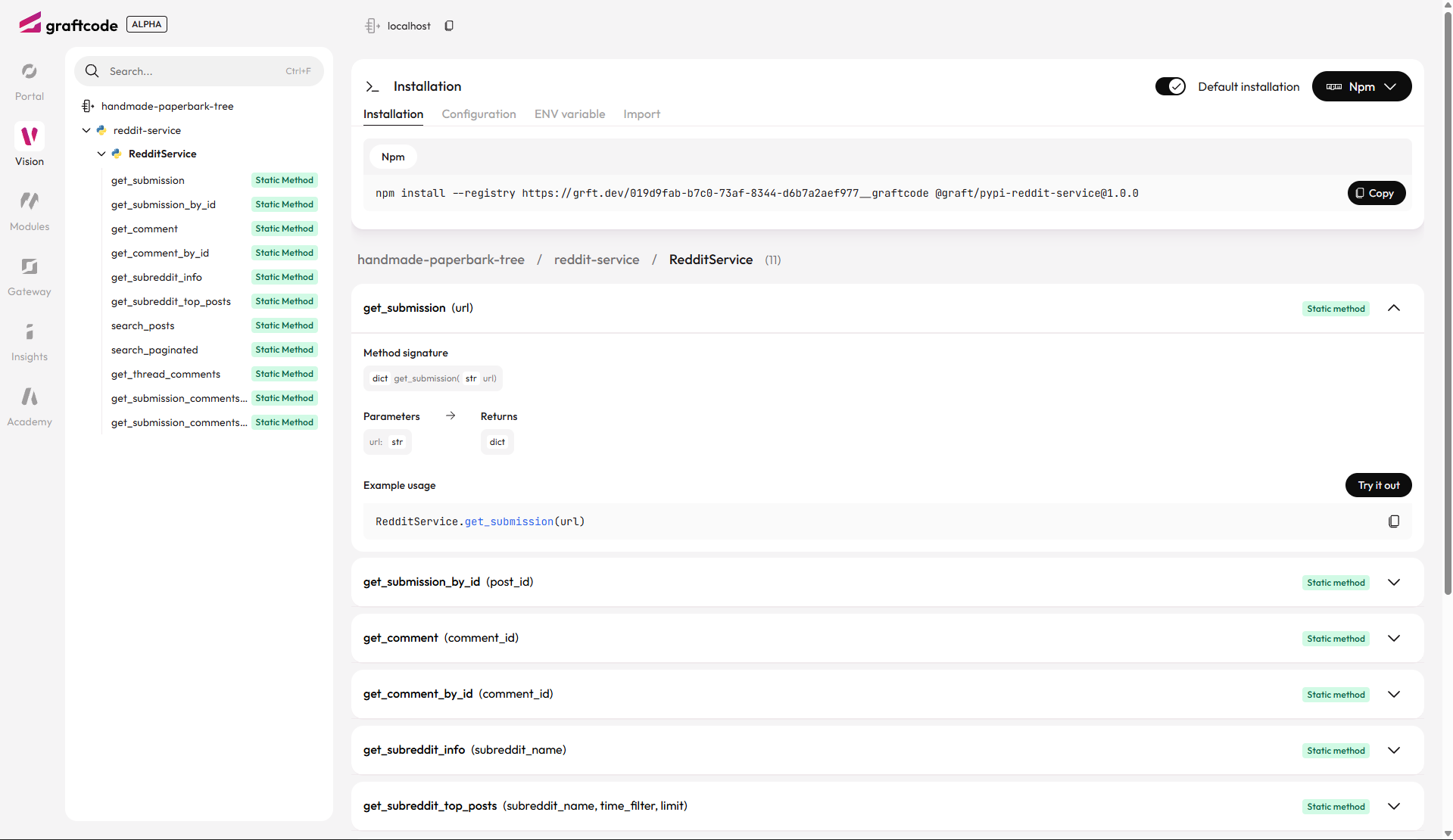
Graftcode Vision, running on port 81, is what generates the method signatures shown above: live documentation derived directly from the running service, not hand-maintained docs that can drift out of sync with the code.
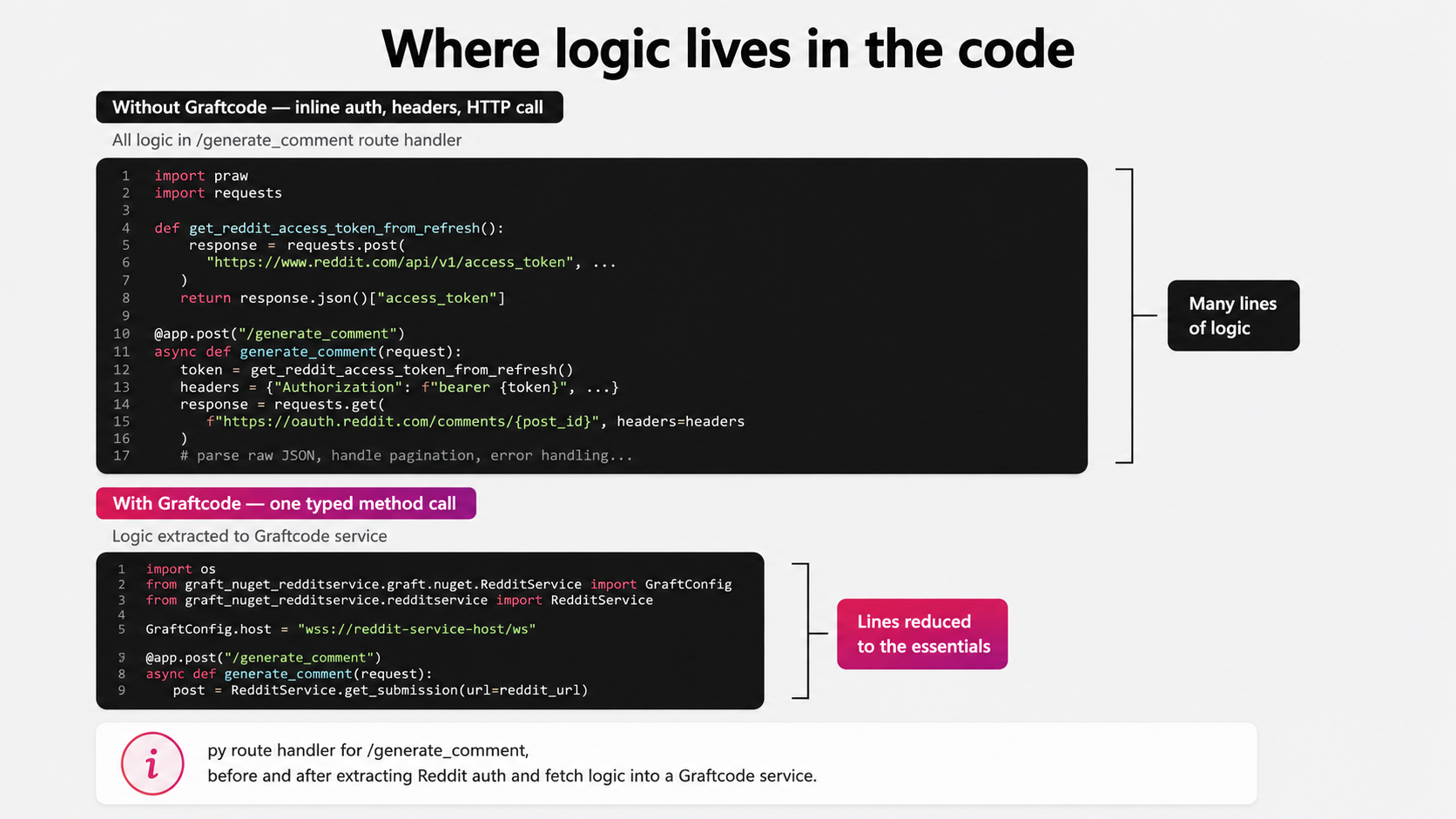
This is a real, counted reduction from an actual migration, not an estimate, drawn from a separate tested example: a route handler that inlined OAuth token refresh, header construction, and a raw HTTP call went from 15 lines down to 5 lines once that logic was extracted into a Graftcode service and called through a single typed method. The original code's trailing comment (# parse raw JSON, handle pagination, error handling...) marks logic the snippet didn't fully show, so the real production reduction is likely larger than 15 → 5; this chart only counts what's concretely shown in that example.
This doesn't make an agent's reasoning better. It reduces the number of places where a correct model can still produce an incorrect outcome because the surrounding integration code gave it an inaccurate or incomplete picture of what a service actually does.
What Graftcode replaces in this specific pattern:
| Without Graftcode | With Graftcode |
|---|---|
| HTTP client and DTOs per service pair the agent orchestrates | Graft installed via package manager |
| Request/response shape inferred by the agent from context | Method signature the agent reads directly |
| Mismatch discovered as a runtime failure mid-workflow | Visible as a package update, fails at compile time if applied |
| Every new service in the workflow adds another integration surface | Overhead stays flat as the workflow grows |
What an Agent-Ready Distributed Architecture Looks Like End to End
Pulling the pieces together, a distributed system built for reliable agent orchestration has:
- Typed interfaces between every service an agent calls, not inferred contracts reconstructed from an OpenAPI spec or a REST client.
- Idempotent operations wherever an agent might retry a call, so a repeated action doesn't produce a duplicated side effect.
- Bounded, single-owner service boundaries, so a wrong call fails in isolation instead of corrupting state that's implicitly shared with other services.
- Immediate, actionable failure signals at the point a contract mismatch actually occurs, not several hops downstream.
- A minimal callable surface per service, few, well-typed methods rather than a wide endpoint list the agent has to search across.
None of these properties are new. They're the same properties that make a distributed system maintainable for a human engineering team. What changes with agents is the cost of getting them wrong: a human catches an odd response and pauses; an agent, by default, keeps going, and the compounding math above means a handful of small gaps in legibility can turn a 95%-reliable-per-step system into one that fails more often than it succeeds by the time a workflow reaches ten steps.
[8]Conclusion: The Architecture Is the Reliability Strategy
The instinct when an agent-orchestrated workflow fails is to look at the model: better reasoning, better prompting, a bigger context window. Often, the more direct fix is architectural: the agent failed because the distributed system it operated across gave it an inaccurate or incomplete picture of what each service actually did. Nothing caught the mismatch until several steps too late.
Distributed systems were never easy to reason about correctly. Agents just remove the human instinct that used to catch wrong assumptions before they propagated. Designing services with typed, minimal, accurately represented interfaces, and getting a fast, direct failure signal when a contract changes, is what makes the difference between a workflow that degrades gracefully at scale and one that fails more often than it succeeds once it's ten steps deep.
To see how Graftcode reduces the integration surface an agent has to orchestrate across, explore Graftcode or go straight to the Graftcode Academy to get started.
[9]FAQs
1. What is the difference between a distributed system and a microservices architecture?
A distributed system is the broader category: any system made of independent processes communicating over a network. Microservices is a specific architectural style within that category, where a system is decomposed into small, independently deployable services organized around business capabilities. All microservices architectures are distributed systems; not all distributed systems (e.g., a distributed database or a peer-to-peer network) are microservices architectures.
2. Why do AI agents fail more often on longer multi-step workflows?
Because task success compounds multiplicatively across steps. If each step succeeds independently with probability p, an n-step workflow succeeds end-to-end at roughly p^n. At 95% per-step reliability, a 10-step workflow only completes correctly about 60% of the time; at 85% per step, that drops to roughly 20%. This is a mathematical property of chained, dependent steps, not a reflection of the underlying model's reasoning quality alone.
3. Does giving an AI agent a wider set of tools make it more reliable?
Not necessarily. One study on agent architecture scaling found that workloads requiring many tools impose a 'tool-coordination tax' that grows disproportionately with the number of tools. A separate evaluation found multi-tool reasoning difficulty was a sharper bottleneck than multi-agent coordination itself. A narrower, well-typed, accurately represented set of callable interfaces tends to produce more reliable orchestration than a wide, loosely typed one.
4. How does Graftcode reduce integration errors in AI agent orchestration specifically?
Graftcode replaces hand-written HTTP clients, DTOs, and serialization logic between services with strongly typed Grafts installed via a package manager. An orchestrating agent reads a method signature instead of inferring a request and response shape from an API spec, and a contract mismatch is visible as a reviewable package update, surfacing as a compile-time failure if applied, rather than a runtime error discovered after the agent has already acted on a wrong assumption several steps into a workflow.
5. What's the most effective architectural fix for unreliable agent-orchestrated workflows?
Reduce the number of places an agent has to infer, rather than read, what a service does. In practice, this means typed interfaces instead of wide REST surfaces, idempotent operations so retries are safe, tightly bounded service ownership so a bad call fails in isolation, and failure signals that surface immediately at the point of a contract mismatch rather than several hops later in the workflow.
/WRITTEN BY