Best Practices for AI-Assisted Development of Distributed Systems
/TABLE OF CONTENTS
/ARTICLE
/ARTICLE
[1]TL;DR
- Distributed systems are harder for AI assistants than monoliths because contracts are implicit, scattered across services, and failures surface far from their cause.
- Explicit, machine-readable contracts and minimal integration boilerplate keep AI-generated changes accurate and PRs reviewable.
- Contract drift should fail loud and early, at build time or import time, not silently in production.
- Deliberate method exposure and direct MCP access provide AI agents with a clean, controlled way to invoke real application logic.
- Safe local testing, incremental rollouts, and human review at service boundaries keep AI-assisted changes reversible and accountable.
AI coding assistants are everywhere in software development now. Cursor, Claude, Windsurf, and GitHub Copilot generate functions, refactor modules, and open pull requests from a single prompt, a real productivity jump for a single service with a handful of files. Point those same tools at a distributed system, though, and the story changes. A dozen services talking over REST, gRPC, and message queues gives an assistant far less to work with in one place: it still writes code quickly, but writes more of the wrong kind, misses context that lives in another repo, and produces pull requests nobody fully trusts.
Codebase shape, not prompting skill, decides how well AI-assisted development works on a distributed system. This post covers what makes distributed systems hard for AI assistants, and eight concrete practices, from contract design to migration sequencing, that keep AI-generated changes accurate, reviewable, and safe to ship. By the end, you'll know what makes distributed systems uniquely difficult for AI assistants, eight practices for making a codebase AI-friendly without compromising architecture, and where tool-calling agents fit into that picture.
[2]What Counts as AI-Assisted Development
"AI-assisted development" now covers more ground than autocomplete. Four overlapping practices fall under the term:
- Inline code generation: autocomplete and chat-based generation inside an IDE (Copilot, Cursor, Windsurf, Claude Code), reading surrounding files for context before suggesting code.
- Agentic coding workflows: an assistant planning a multi-step change, editing multiple files, running tests, and opening a pull request with limited human steering per step.
- AI-assisted code review: bots reviewing diffs for bugs, style violations, or drift from established patterns before a human reviewer looks at it.
- Tool-calling agents (MCP-based): assistants that call live application methods as tools during a session, via the Model Context Protocol, not just read and write code.
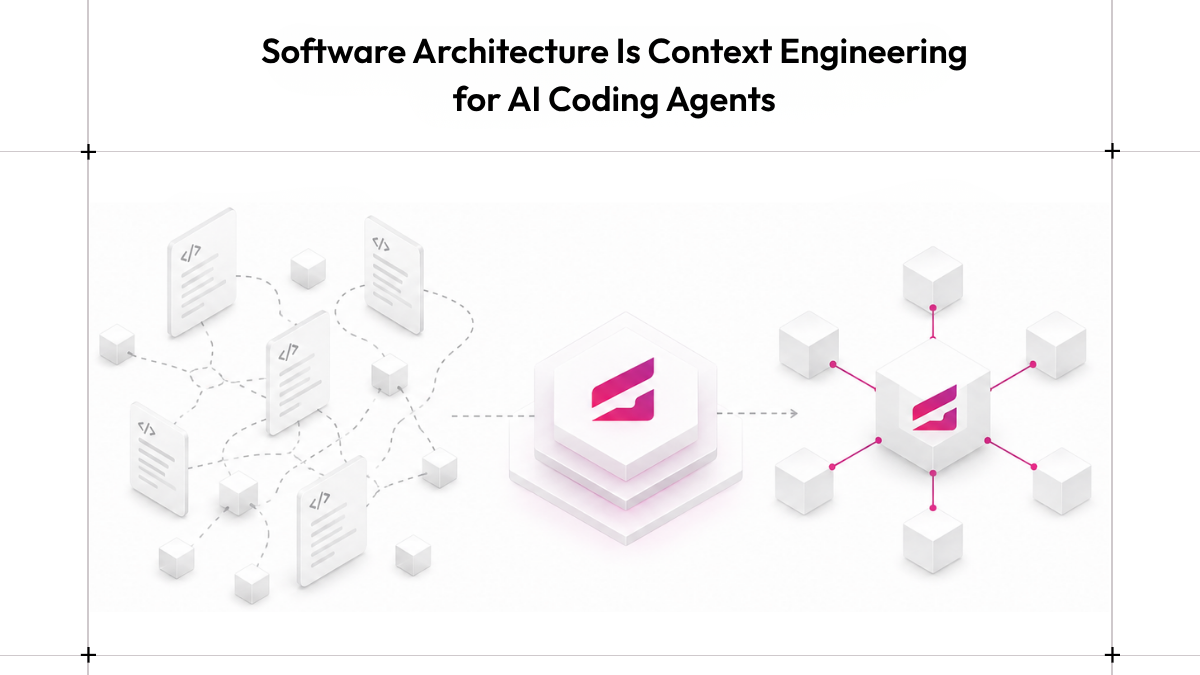
Context is the resource all four consume the same way: how much of the codebase an assistant reads, and how accurately that code reflects the system right now. Distributed systems spend that resource fastest.
[3]Why Distributed Systems Break the Usual AI-Assistance Playbook
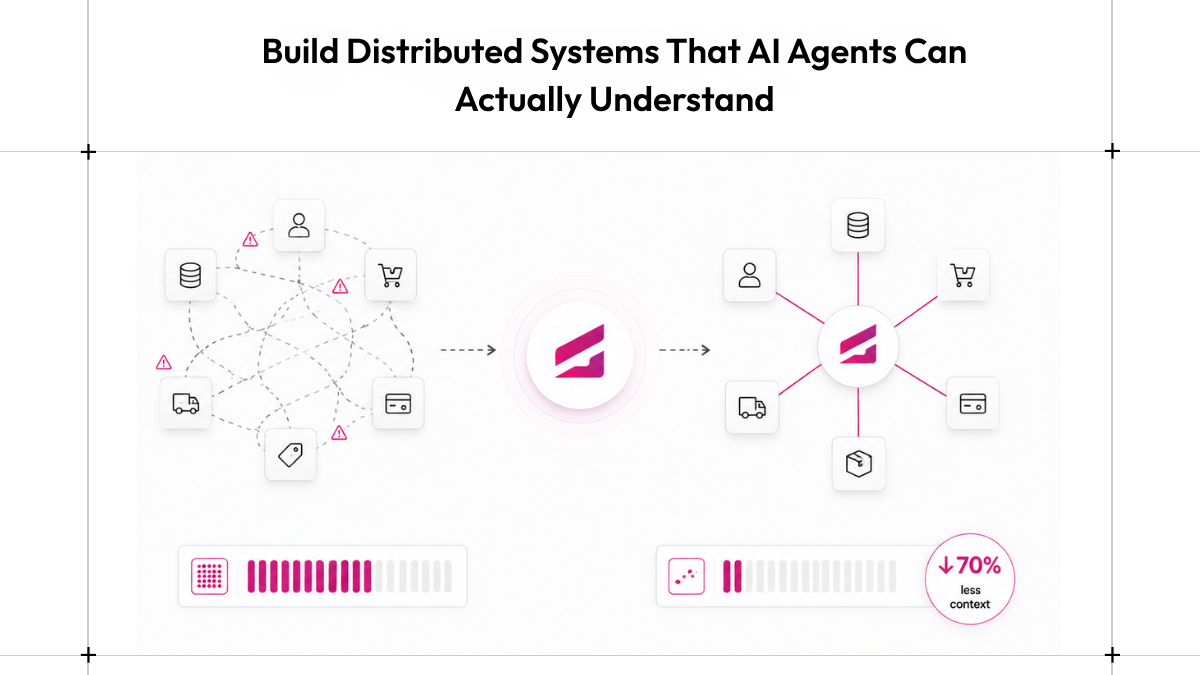
A monolith keeps most of what an assistant needs in one place: a function's callers, its types, its tests, all reachable in the same repo. Distributed systems split that across services and add three problems that single-service work never runs into.
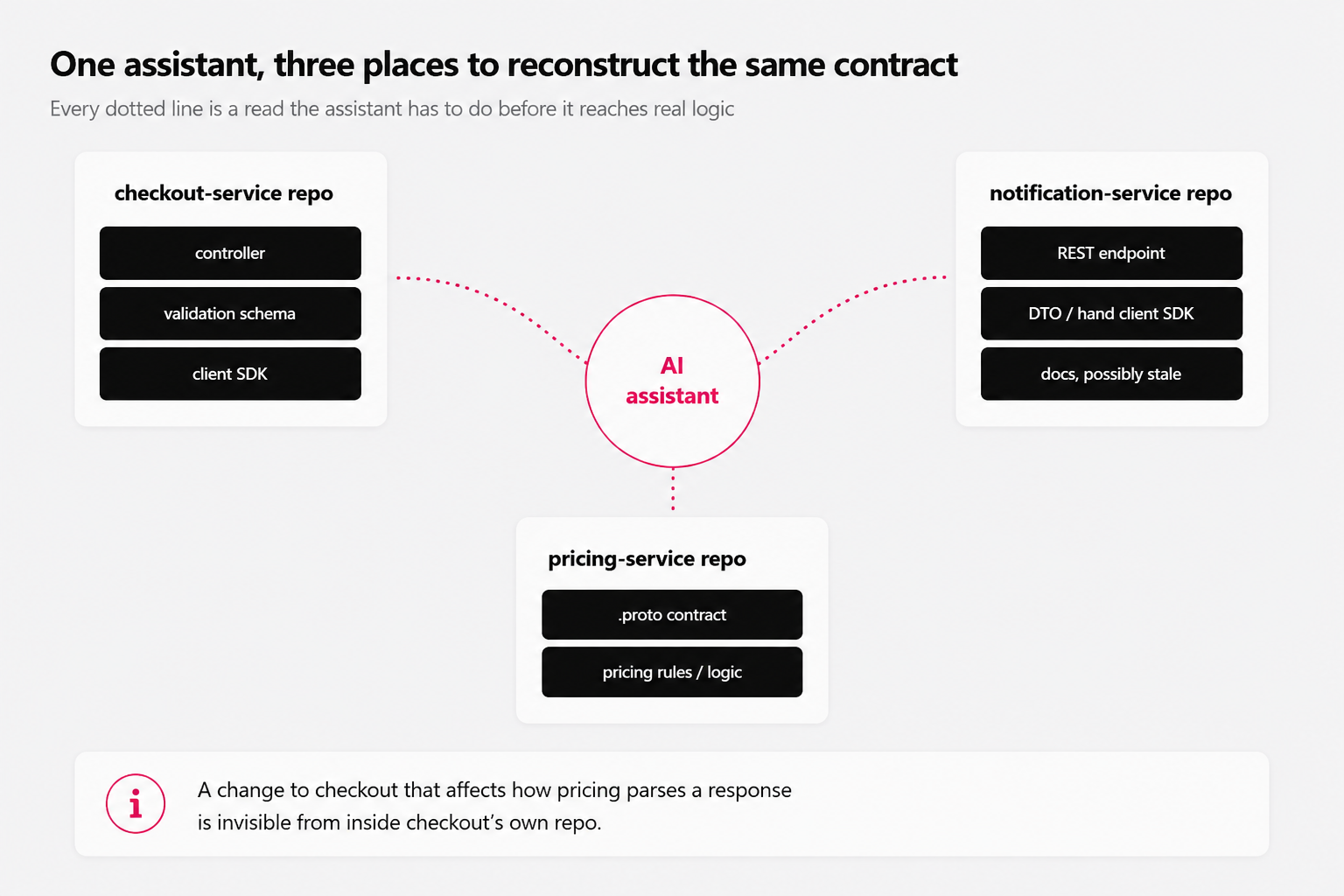
- Cross-service reasoning needs context the assistant can't see. A change to Service A that affects how Service B parses a response is invisible to an assistant working inside Service A's repo. It can generate a change that compiles and passes local tests while quietly breaking a caller it never saw.
- Contracts are often implicit, not machine-legible. A REST endpoint's actual shape lives in a controller, a validation schema, and a hand-maintained client SDK, three places that can drift from each other. An assistant has to infer the real contract by reading all three, when it should read one.
- Failures surface far from their cause. A bad change in a monolith usually fails fast, close to where it happened. In a distributed system, the same bad change can pass every test in the service that made it and only surface as a runtime error two services downstream, well after the AI-generated PR merged.
None of this rules AI assistants out for distributed systems work. It means the codebase needs a shape that lets the assistant focus on business logic, not on reconstructing the integration layer from scratch every session.
[4]Best Practice 1: Make Service Contracts Explicit and Machine-Readable
Contract clarity comes before any AI tooling decision. A service's contract needs to be something a machine reads directly, not something reverse-engineered from code.
OpenAPI specs and .proto files set the baseline here. They give humans and AI assistants a single place to check what a service accepts and returns, rather than inferring it from a controller and a validation schema that may or may not agree.
Contracts generated directly from a provider's real method signatures go further than hand-authored specs that must be kept in sync manually. A strongly typed interface generated from the provider's actual methods and installed in the calling service, rather than a separately maintained schema, removes the sync problem entirely. There's nothing to drift, because there's nothing hand-duplicated.
AI-generated changes need this more than human ones do. A developer might notice an OpenAPI spec is a version behind. An assistant generating a client call against a stale spec has no such instinct; it produces code against whatever contract it's given, accurate or not.
[5]Best Practice 2: Cut the Integration Boilerplate Out of What AI Has to Read
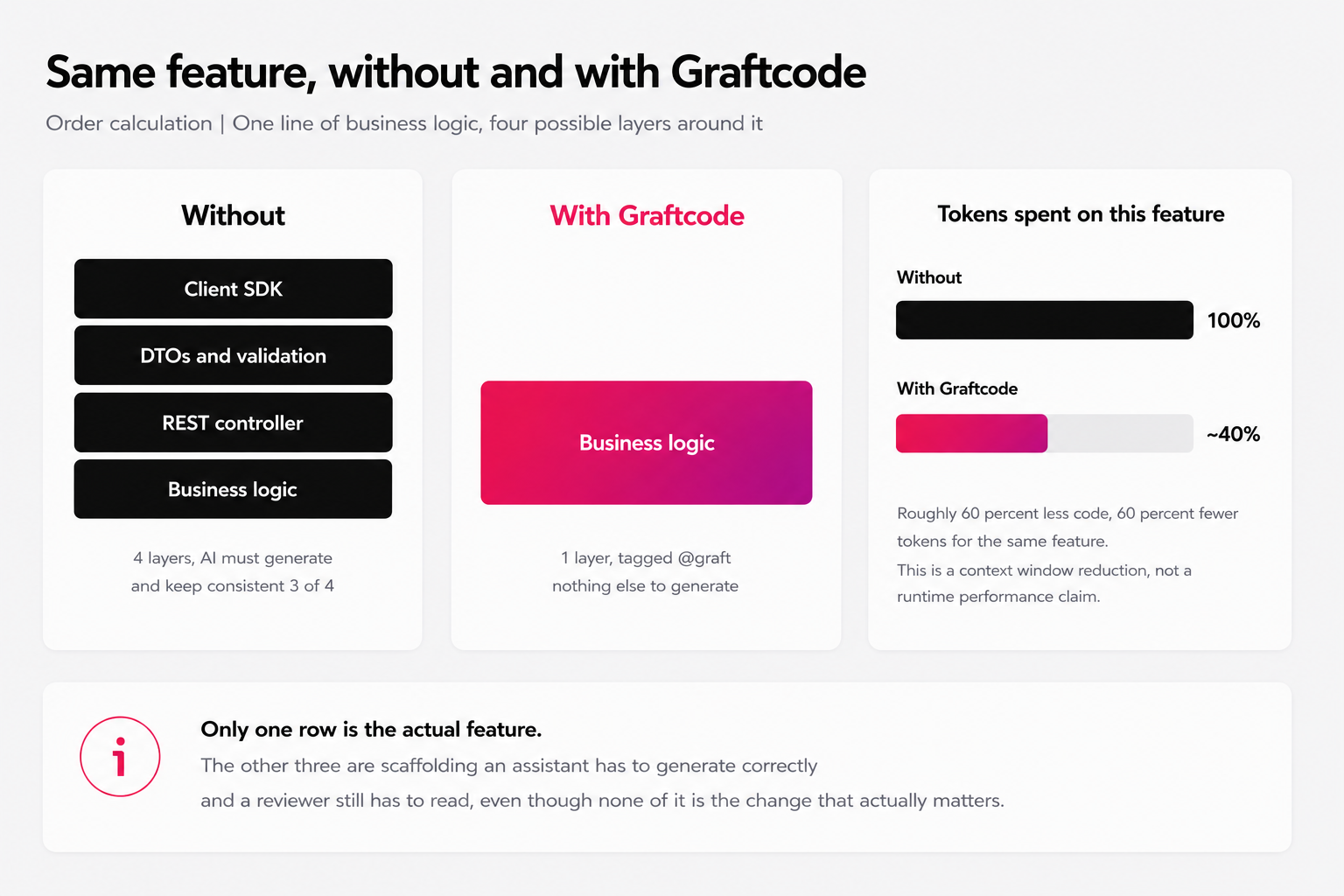
Order calculation is a useful stand-in for any typical feature. Adding it to a REST API asks an AI assistant to write four things, and only one of them is the actual feature:
// 1. Business logicfunction calculateOrder(userId, items) {return { userId, total: items.reduce((s, i) => s + i.price, 0) };}// 2. REST controllerapp.post('/orders', async (req, res) => {const result = calculateOrder(req.body.userId, req.body.items);res.json(result);});// 3. DTOs & validationconst OrderSchema = z.object({userId: z.string().uuid(),items: z.array(z.object({productId: z.string(),quantity: z.number().int().positive(),price: z.number().positive()})).min(1)});// 4. Client SDKasync function createOrder(userId, items) {const res = await fetch('/orders', {method: 'POST',headers: { 'Content-Type': 'application/json' },body: JSON.stringify({ userId, items })});return res.json();}
| Layer | Without Graftcode | With Graftcode |
|---|---|---|
| Business logic | Hand-written | Hand-written |
| REST controller | Hand-written, AI must generate | Not needed |
| DTOs & validation schema | Hand-written, AI must generate | Not needed |
| Client SDK | Hand-written, AI must generate | Not needed |
Only the business logic row is the actual feature. The other three rows are integration scaffolding an assistant has to generate correctly, keep consistent with each other, and that a reviewer still reads even though none of it is the change that matters.
Graftcode's AI-assisted workflows are built to remove exactly this. Mark the method for exposure, and the feature is just the business logic:
function calculateOrder(userId, items) {return { userId, total: items.reduce((s, i) => s + i.price, 0) };}module.exports = { calculateOrder };
No controller for the AI to generate. No client SDK to keep in sync. No validation schema duplicating what the function signature already says. The Graftcode Gateway hosts this service and exposes the annotated method to callers; on the calling side, a generated Graft, a strongly-typed interface installed via the calling service's package manager, is what actually gets invoked. Either way, the calling code and the AI reasoning about it only ever see the function signature.
Graftcode's own before/after comparison shows this reduces code by roughly 60% and tokens by 60% for the same feature. That's a reduction in codebase size and context-window usage, not a runtime performance claim; fewer tokens spent reading boilerplate means more context budget goes to the logic under review, and AI-generated pull requests stay close to the size of the real change instead of ballooning with repeated controller/DTO/client patterns across every touched service.
Review speed benefits too. A PR that touches only business logic is one a reviewer can evaluate in minutes. A PR where the assistant also regenerated three DTOs and a client wrapper needs a line-by-line check just to confirm the boilerplate is correct, which defeats a lot of the point of using an assistant in the first place.
[6]Best Practice 3: Catch Contract Drift Before Runtime, Not After
Removing boilerplate cuts what an assistant writes. It doesn't stop a contract mismatch from reaching production; that takes a contract that fails loud and early when it breaks.
Untyped REST setups turn drift into a runtime problem. A renamed response field surfaces as a KeyError or a null on the caller's side; a renamed request field surfaces as a validation error or unexpected behavior on the server. Neither gets caught before the code runs.
Strongly-typed generated interfaces catch this earlier, sometimes as soon as an updated interface package is applied, before the calling service even rebuilds. How early depends on the language. Compiled or statically typed languages (Java, C#, TypeScript checked with tsc) fail at build time. Plain JavaScript and Python have no compiler to catch it, so the mismatch surfaces as an import or attribute error at runtime instead, or via an optional type checker if one is configured. Either way, it's an early, defined failure point rather than a silent one buried in production traffic.
This distinction matters more once AI agents write the calling code. A developer making a manual change might pause to double-check an interface before shipping. An agent moving through a multi-step task has no such instinct; it needs the tooling itself to catch the mismatch, because it generates confidently against whatever contract it was last shown.
[7]Best Practice 4: Expose Only the Methods You Intend for Agents
Live method calls turn "what's reachable" from an abstraction into a real access boundary, once an assistant can call methods rather than just read and write code.
A Graftcode Gateway exposes methods through explicit access policies, specific classes, methods, namespaces, or files a team chooses to surface, not every public method by default. Anything left unexposed doesn't exist as far as a caller, human or AI, is concerned.
Autonomous agents make this distinction matter more than it did for human developers. A developer reading source code usually respects an internal-only convention even without anything stopping them from calling an unexported method. An agent working through a task has no such judgment; a reachable method is fair game. Access control at the Gateway enforces the boundary regardless of what an agent decides is a reasonable path to its goal.
[8]Best Practice 5: Give Agents a Clean Path to Call Real Code via MCP
Tool-calling agents raise the same integration-layer problem one step removed. Getting an agent in Cursor or Claude to invoke application logic, not just read and suggest it, conventionally means hand-building an MCP server: schemas, wrapper handlers, and transport wiring, all kept in sync by hand whenever the underlying method changes.
A fraud-risk scoring method makes this concrete. Say the method takes a transaction plus recent account history and returns a score with the reasons behind it:
// Hand-written MCP server for a single methodconst server = new McpServer({ name: 'risk-tools', version: '1.0.0' });server.tool('evaluateTransaction', {description: 'Score a transaction for fraud risk using account history',inputSchema: {type: 'object',properties: {transaction: {type: 'object',properties: {amount: { type: 'number' },currency: { type: 'string' },merchantId: { type: 'string' },country: { type: 'string' },},required: ['amount', 'currency', 'merchantId', 'country'],},accountId: { type: 'string' },recentTransactionCount: { type: 'number' },},required: ['transaction', 'accountId'],},handler: async ({ transaction, accountId, recentTransactionCount }) => {const result = evaluateTransaction(transaction, accountId, recentTransactionCount);return {content: [{ type: 'text', text: JSON.stringify(result) }],};},});const transport = new StreamableHTTPTransport({ path: '/mcp' });await server.connect(transport);
Every nested field in that schema, request, and response has to be manually mirrored and kept in sync whenever the underlying logic changes. That's a second integration layer, separate from the service's REST API and its calls to other services, built solely so an agent can reach one method.
Graftcode's MCP support turns existing public methods into MCP tools directly, without a hand-built server in between:
class RiskEngine {evaluateTransaction(transaction, accountId, recentTransactionCount) {const score = this.scoreTransaction(transaction, recentTransactionCount);return {score,flagged: score > this.riskThreshold,reasons: this.explainScore(transaction, score),};}}module.exports = { RiskEngine };
Running the Graftcode Gateway against the service automatically turns its exposed methods into callable MCP tools, subject to the same access policies as in the previous section. Parameter names, types, and doc comments carry over as the tool definition, so the nested transaction object and the score-plus-reasons response come straight from the method's real signature. An agent in Cursor, Claude, or another MCP-compatible client calls evaluateTransaction directly, with no parallel schema and no separate server process built just for agent access.
One method, one source of truth, used by the rest of the application, by other services calling it, and by AI agents calling it as a tool. Three duplicated versions of the same logic can't quietly drift apart if only one version exists.
[9]Best Practice 6: Give AI Assistants a Safe, Reversible Testing Environment
Clean contracts and controlled exposure still leave one gap: a place for an agent to verify a cross-service change without standing up the full infrastructure for every iteration.
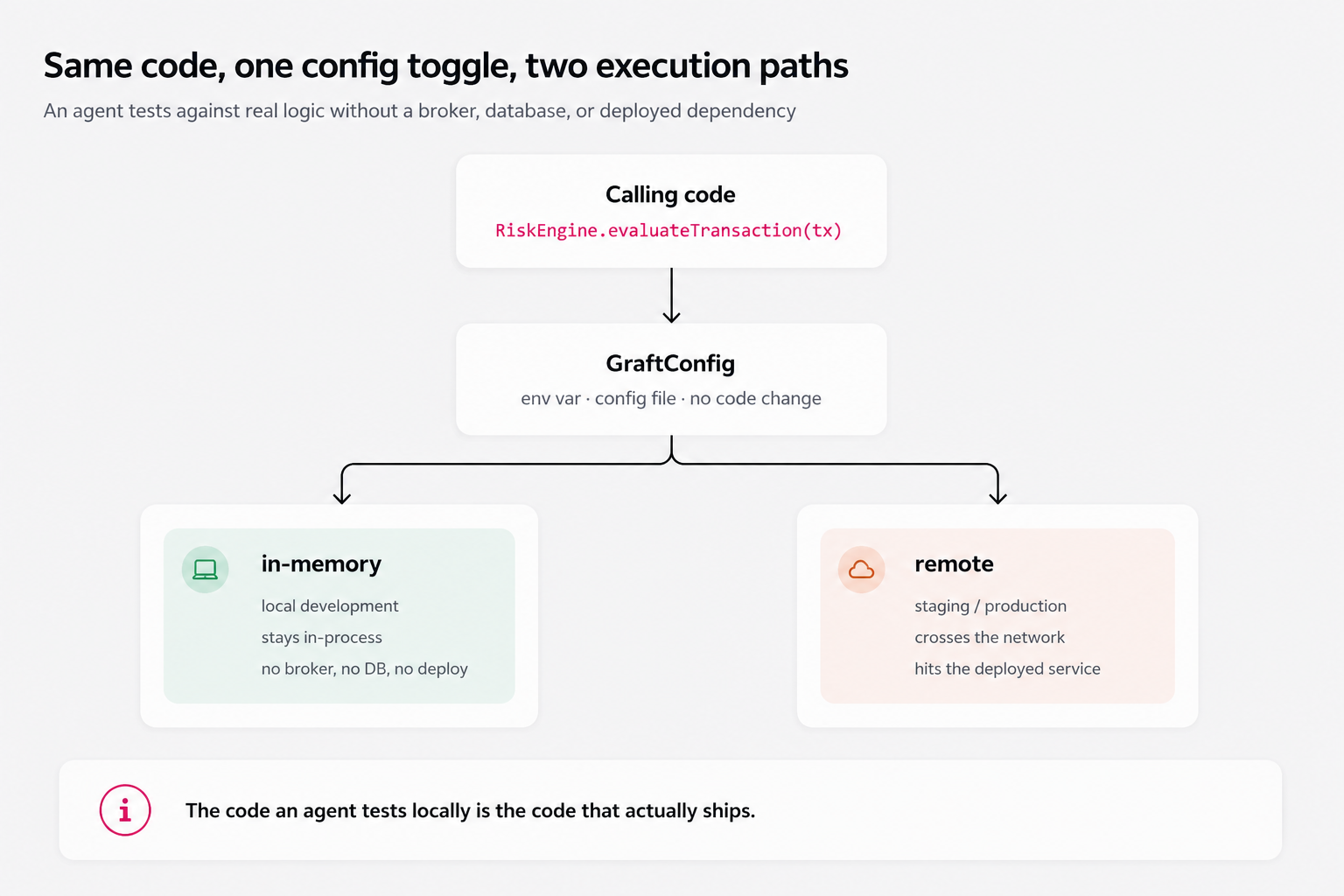
A local, in-memory execution path closes that gap. The same calling code that runs remotely in production can also run in-process during local development, so an agent validates a change against real logic without a broker, database, or deployed dependency running locally. Switching between the two paths is a configuration change, not a code change, so the code an agent tests locally is the one that actually ships.
Feature flags and staged rollouts add a second layer of safety. AI-generated changes reach production incrementally and reversibly rather than through a single all-or-nothing deploy, which helps with any change and even more so when a reviewer's read of an AI-generated diff might miss something a gradual rollout would catch.
[10]Best Practice 7: Structure Migrations So Agents Work Incrementally
Monolith-to-microservices migrations attract a lot of AI-assisted work, since mechanical extraction is exactly the kind of task assistants handle well. A migration stays safe for an agent to touch only if it's broken into small, independently reversible steps.
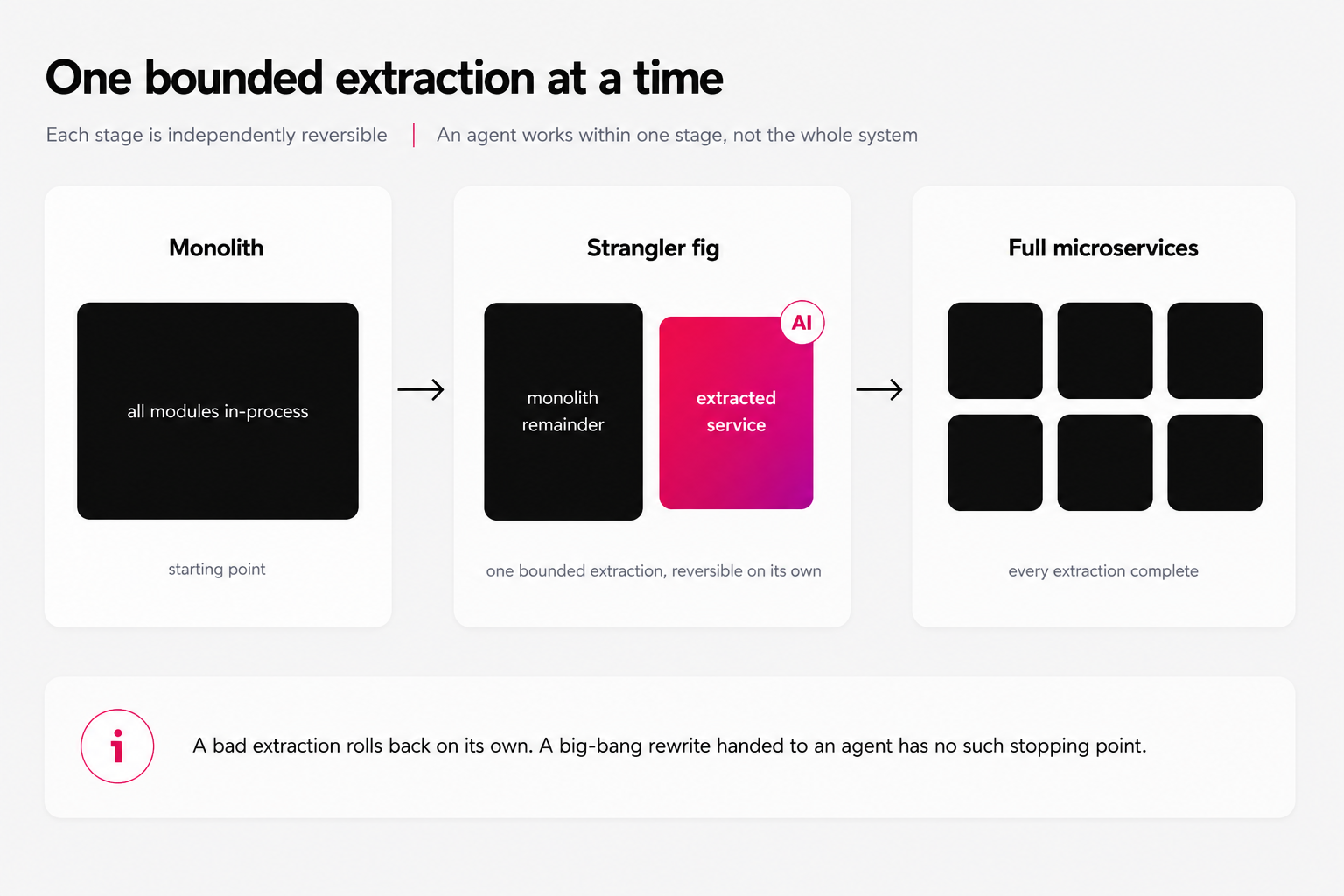
Strangler Fig-style extraction fits this well: extract one service at a time, keep the monolith running throughout, and make each extraction reversible on its own. An agent, or a human directing one, takes one bounded extraction as a task, verifies it in isolation, and rolls it back without touching anything else in flight. A big-bang rewrite handed to an assistant has no such safe stopping point if something in the middle goes wrong.
Earlier practices still apply inside each extraction step. The newly extracted service needs an explicit, generated contract rather than a hand-maintained one, and the calling code left in the monolith should switch between in-process and remote calls through configuration, not a rewrite.
[11]Best Practice 8: Keep Humans in the Loop Where It Matters
None of the practices above aim to make AI-assisted development fully autonomous. They make the parts AI already handles well, glue code, boilerplate, mechanical migration steps, test scaffolding, safe to hand off, so human attention stays on the parts that need it.
Architectural boundary decisions stay with the team. Where a service split happens, what belongs in which service, and what a contract promises callers are calls worth making deliberately, not delegating to an agent's judgment. Observability across services, staged rollouts, and mandatory review for any change crossing a service boundary stay necessary, no matter how much code an AI wrote. Earlier practices exist to make that review fast and focused, not to remove it.
[12]Bringing These Practices Together Into One Reference Workflow
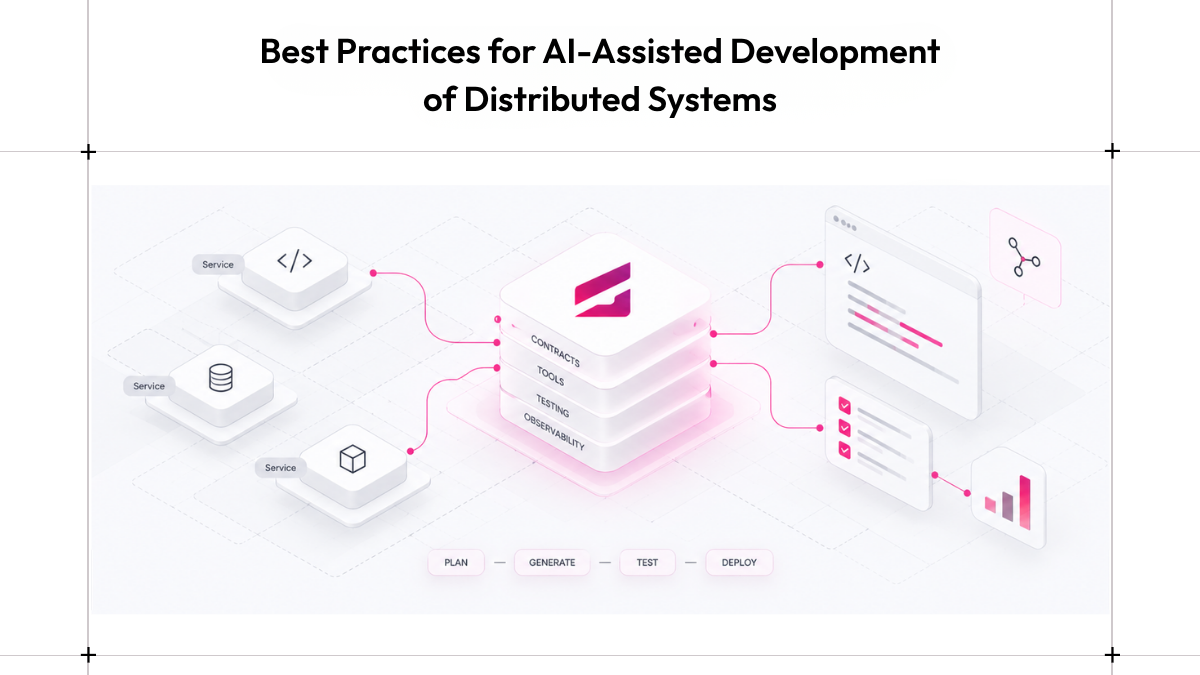
Put together, these eight practices form a rough sequence for any team building AI-assisted development into distributed systems work.
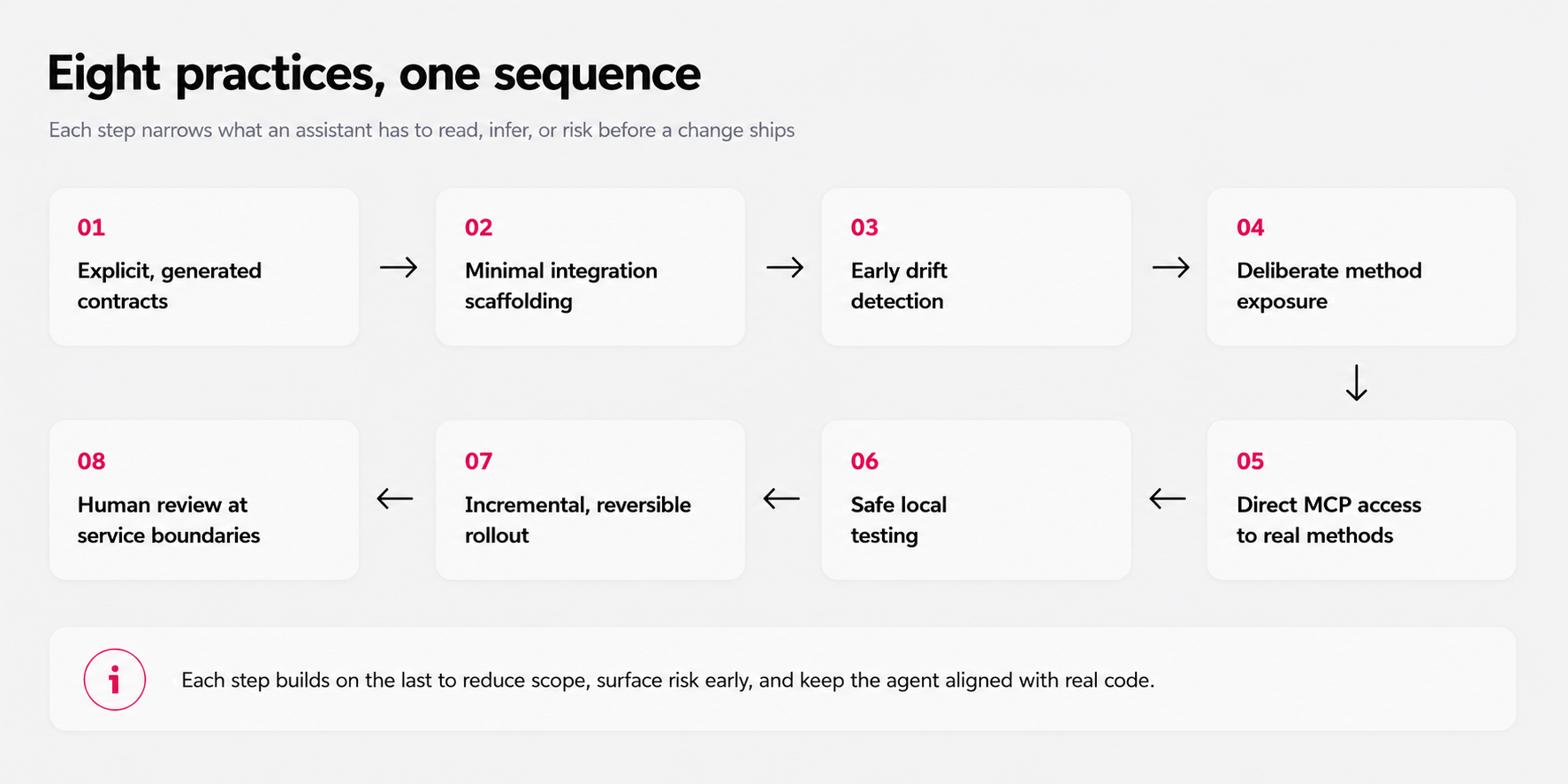
| Practice | Why It Matters |
|---|---|
| Explicit, generated contracts | One accurate source of truth per service, not three hand-maintained artifacts to reconcile |
| Minimal integration scaffolding | Context budget and PR size go toward business logic, not repeated boilerplate |
| Early drift detection | A broken contract fails at the earliest possible point, not in production |
| Deliberate exposure | Agents reach only what a team explicitly intended to expose |
| Direct MCP access to real methods | Tool-calling agents skip a second, parallel integration layer |
| Safe local testing | An agent validates a cross-service change without full infrastructure |
| Incremental, reversible rollout | Migrations and day-to-day changes both keep a safe stopping point |
| Human review at service boundaries | Architectural judgment stays with the team, not the assistant |
[13]Conclusion: Making AI-Assisted Development Work at Scale
AI-assisted development doesn't get worse at distributed systems because the models are less capable there. It gets worse because distributed systems hand an assistant more scaffolding to read, more implicit contracts to infer, and more room for a change to fail somewhere the assistant never looked. The eight practices above, explicit contracts, minimal integration boilerplate, early drift detection, deliberate exposure, direct MCP access, safe local testing, incremental rollout, and human review at service boundaries, all point to the same fix: change the shape of what the assistant is working with, and the same tools that struggle across a dozen loosely-connected services perform a lot closer to how they perform in a single, well-contained one.
If integration boilerplate is slowing your AI-assisted workflows, explore how Graftcode removes it, or start by seeing how Graftcode exposes your code as MCP tools if tool-calling agents are the more immediate problem.
[14]FAQs
Do I need to rewrite existing services to make them AI-assistant-friendly with Graftcode?
No. Explicit contracts, controlled exposure, and direct MCP access are designed to layer on top of existing public methods and APIs, not to force a rewrite. Existing REST or gRPC endpoints can stay in place; the goal is avoiding a second, duplicated integration layer just for AI or agent access.
What's the difference between hand-building an MCP server and exposing methods directly as MCP tools with Graftcode?
A hand-built MCP server means writing tool schemas, wrapper handlers, and transport wiring as a separate artifact from the service's actual code, a second integration layer to maintain alongside the first. Exposing existing public methods directly as MCP tools skips that duplication: the method's real signature is what the agent sees, so nothing separate needs to stay in sync when it changes.
Does AI-assisted development work differently for distributed systems than for a single application?
Not in terms of underlying model capability; the difference is how much of the codebase the assistant has to read before it reaches the actual logic. A single service keeps most of what an assistant needs in one place. A distributed system spreads that across services and hand-maintained contracts, which is why deliberate contract design and scoped exposure matter in the first place.
Is a strongly-typed contract always caught at compile time?
Only in compiled or statically typed languages. Dynamic languages like plain JavaScript or Python have no compiler to catch mismatches; instead, they surface as import or attribute errors at runtime, or via an optional type checker if one is configured. Either way, detection happens earlier and is more defined than an untyped REST contract drifting silently until a caller hits it in production.
Can AI agents be trusted to make architectural decisions in a distributed system?
Not on their own. Agents handle mechanical, well-bounded work well: glue code, boilerplate, scaffolded migration steps, but decisions like where a service boundary sits or what a contract should promise callers are judgment calls a team should make deliberately. Observability, staged rollout, and human review at service boundaries remain necessary, no matter how much surrounding code is AI-generated.
/WRITTEN BY