Kafka vs RabbitMQ: Which Message Broker Fits Your Microservices Stack?
/TABLE OF CONTENTS
/ARTICLE
/ARTICLE
[1]TLDR
- Kafka and RabbitMQ solve the same category of problem with different architectural bets. Kafka is a distributed append-only log built for high-volume streaming, replay, and exactly-once processing within its supported transactional workflows; RabbitMQ is a push-based message broker built for complex routing, task queues, low-latency delivery, and operational simplicity.
- The choice between them comes down to six dimensions: throughput vs latency, routing complexity, replay requirements, exactly-once guarantees, operational overhead, and protocol support. For most teams at a typical scale, RabbitMQ wins on simplicity, while Kafka wins when volume or replay is non-negotiable.
- Graftcode reduces the integration layer that sits above whichever broker you choose: the hand-written HTTP clients, DTOs, and serialization code that pile up when consumers need to call downstream services after a message lands. Because that integration layer is decoupled from the broker itself, teams can switch between Kafka, RabbitMQ, or another broker without rewriting the downstream service calls that sit above it.
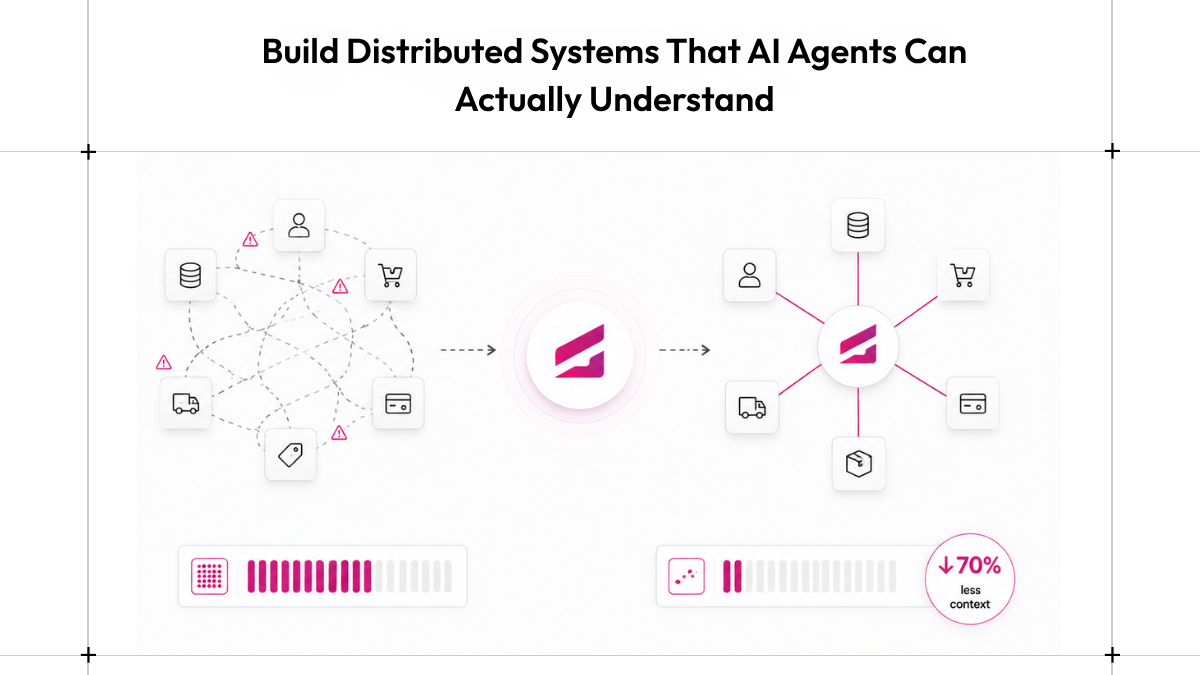
- In AI-native microservices, Graftcode also reduces LLM token consumption. With less integration code, DTOs, and serialization logic in the codebase, an LLM working on the project has less non-business-logic surface to parse before it can reason about what a service actually does. This applies whether the integration in question is a REST call, a Kafka consumer, or a RabbitMQ handler; in each case, Graftcode reduces the integration work that needs to be written and maintained around it, cutting context load per inference and compounding into meaningful cost savings as service interactions scale.
Kafka and RabbitMQ dominate the message broker decision for backend teams; they show up in the same job descriptions, the same architecture diagrams, and the same "which should I use?" threads. That creates the impression they're interchangeable, which they aren't. Each makes a fundamentally different architectural bet, and picking the wrong one for your workload has real consequences.
Most broker comparisons stop at the comparison. This one goes further, covering what Kafka does well, what RabbitMQ does well, where a broker adds overhead for problems it wasn't designed to solve, and where Graftcode reduces the integration complexity that sits above whichever broker you pick.
[2]What message brokers actually solve in a microservices system
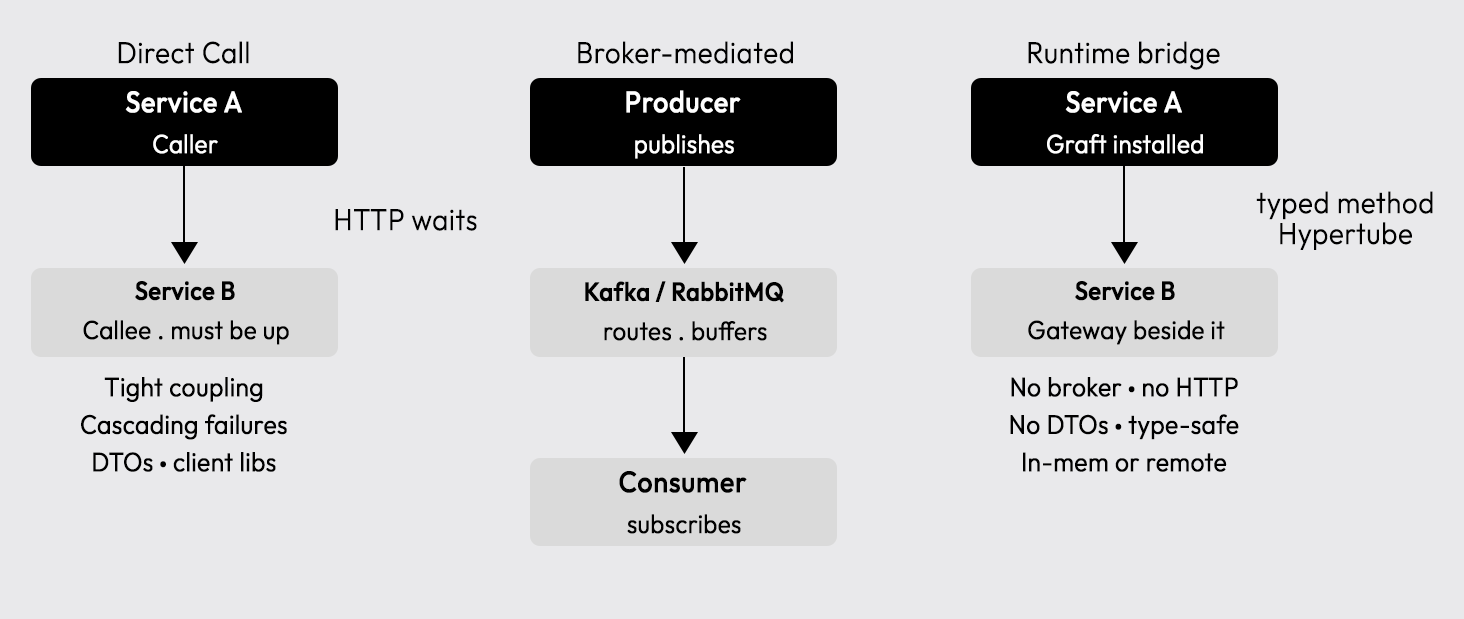
Services in a monolith call each other through function calls, fast, synchronous, and type-safe. When those services split into independent processes, that direct call becomes a network call, and network calls fail in ways function calls don't: timeouts, connection drops, slow consumers blocking fast producers, cascading failures.
A message broker sits between services and changes the failure model to address those problems:
- Decoupling: The producer emits a message and moves on. It doesn't know who's consuming or whether they're online.
- Buffering: The broker holds messages when consumers are slow or temporarily unavailable.
- Fan-out: One message can reach many independent consumers without the producer knowing about any of them.
At the simplest level, an event-driven system has three main roles:
| Role | Responsibility | Example |
|---|---|---|
| Producer | Emits messages when state changes | The payment service publishes a payment.completed |
| Broker | Stores, routes, and delivers messages | Kafka cluster, RabbitMQ node |
| Consumer | Subscribes and processes messages | Notification service, billing updater, analytics sink |
Kafka and RabbitMQ both serve as brokers. What differs is the architecture underneath, and that architecture determines what each tool is actually good at.
[3]How Kafka works and what it is built for
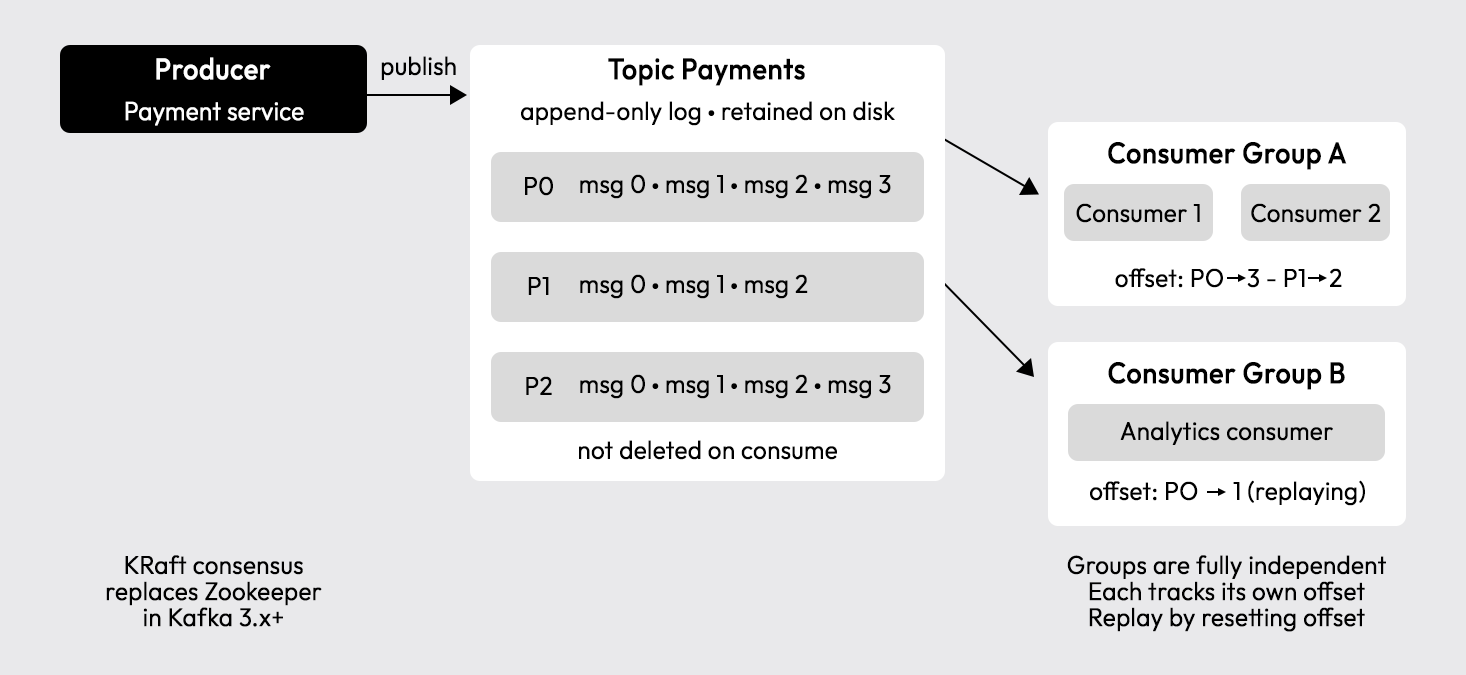
Kafka is a distributed, append-only log, not a traditional message queue. When a producer sends a message to Kafka, it gets written to a topic, specifically, to one of that topic's partitions. Partitions are ordered, immutable sequences of records stored on disk. Kafka doesn't push messages to consumers; consumers pull from partitions at their own pace, tracking their position with an offset. When a consumer processes a message, nothing is deleted. The message stays in the log until the configured retention period expires.
This architecture has specific consequences:
- Replay is native. A consumer can reset its offset and reprocess the entire topic history.
- Multiple consumer groups are independent. Consumer Group A and Consumer Group B can both read the same partition without interfering with each other.
- Ordering is guaranteed within a partition. Across partitions, ordering is not guaranteed.
- Throughput scales with partitions. Add partitions, add parallelism.
Kafka's KRaft (Kafka Raft consensus) protocol matured through the 3.x releases and fully replaced ZooKeeper with Kafka 4.0, removing a significant operational dependency. Cluster management is simpler as a result, but partition rebalancing, offset management, and tuning for high-throughput workloads still require meaningful ops investment.
| Property | Kafka |
|---|---|
| Model | Distributed log (pull-based) |
| Retention | Configurable, hours to indefinite |
| Routing | Topic + partition key |
| Consumer model | Pull, offset tracked per consumer group |
| Protocol | Kafka Wire Protocol (binary) |
| Throughput | 1M+ msgs/sec |
| Ordering | Per partition |
| Exactly-once | Yes, idempotent producers + transactions API |
| Ops complexity | High |
Kafka fits when: event sourcing, stream processing, log aggregation, audit trails, real-time analytics pipelines, and any workload that requires replay or high-volume fan-out.
[4]How RabbitMQ works and what it is built for
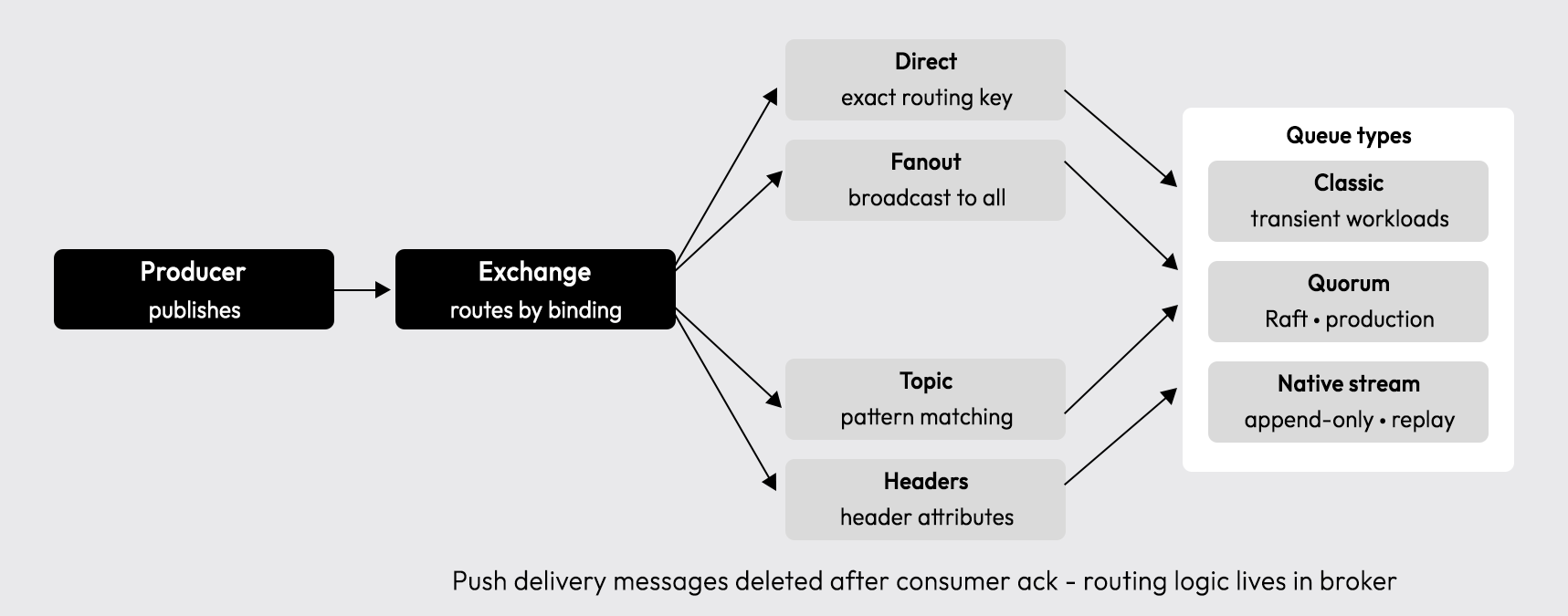
RabbitMQ is a traditional message broker. It implements AMQP (Advanced Message Queuing Protocol) and uses a push-based delivery model; the broker delivers messages to consumers as soon as they arrive, rather than waiting for consumers to pull them.
The core routing mechanism is the exchange. Producers publish to exchanges, not directly to queues. Exchanges route messages to queues based on binding rules:
- Direct exchange: Routes by exact routing key match
- Fanout exchange: Broadcasts to all bound queues, ignoring the routing key
- Topic exchange: Routes by pattern matching on routing keys (
order.\*,#.failed) - Headers exchange: Routes by message header attributes instead of the routing key
This routing logic lives in the broker, so changes to routing behavior, direct, fanout, topic, or header-based, don't require changes to producer or consumer code. It's worth noting that RabbitMQ's standard exchanges route based on message metadata (routing keys, key patterns, and headers), not by inspecting arbitrary fields inside the message body itself.
Modern RabbitMQ (3.9+) supports three queue types:
- Classic queues: Backward-compatible, suitable for transient workloads
- Quorum queues: Built on Raft consensus, strong consistency, recommended default for production
- Native streams: Append-only log with consumer offsets, Kafka-like replay within RabbitMQ. A single cluster can serve both traditional queuing and streaming workloads.
| Property | RabbitMQ |
|---|---|
| Model | Message queue (push-based) |
| Retention | Until acknowledged (or TTL) |
| Routing | Exchange types (direct, fanout, topic, headers) |
| Consumer model | Push, broker tracks per-message delivery |
| Protocol | AMQP, MQTT, STOMP |
| Throughput | ~40K–100K msgs/sec |
| Ordering | Per queue |
| Exactly-once | Application-level deduplication required |
| Ops complexity | Low–medium |
RabbitMQ fits when: complex metadata-based routing, task queues, background job processing, request-reply patterns, multi-protocol environments, and workloads where per-message latency matters more than raw throughput.
[5]Kafka vs RabbitMQ: head-to-head across six dimensions
Throughput and latency
Kafka handles 1M+ messages per second under load. RabbitMQ typically handles 40K–100K messages per second. The gap is architectural: Kafka's sequential disk writes and pull-based model are built for volume. RabbitMQ's push model prioritizes per-message latency; it gets individual messages to consumers faster, but doesn't scale to Kafka's throughput ceiling.
Verdict: Kafka for volume. RabbitMQ for low-latency individual message delivery.
Message routing
RabbitMQ's exchange model handles complex routing natively, routing by header, routing key, pattern, or destination. Kafka routes by topic and partition key only. Any routing logic beyond that lives in producer or consumer code.
Verdict: RabbitMQ for complex routing. Kafka for simple high-volume fan-out.
Message retention and replay
Kafka retains messages for a configurable window regardless of whether they've been consumed. Replay is a first-class feature: reset an offset and reprocess the full history. RabbitMQ deletes messages after acknowledgment by default. Native streams add replay capability, but it's secondary to the queuing model.
Verdict: Kafka if replay is a hard requirement.
Delivery guarantees
Both support at least one delivery. Kafka's idempotent producers combined with its transactions API give exactly-once semantics within its supported transactional workflows, Kafka-to-Kafka reads, processes, and writes. That guarantee doesn't extend automatically to external side effects like database writes, payment calls, or email sends; those still require the consumer to implement idempotency itself. RabbitMQ requires application-level deduplication to achieve any exactly-once guarantee, whether the side effect is internal or external.
Verdict: Kafka for exactly-once guarantees without application-level workarounds.
Operational complexity
RabbitMQ runs as a single binary with a management UI and is straightforward to operate. Kafka's KRaft removed the Zookeeper dependency, but cluster management, partition rebalancing, and consumer group coordination still require meaningful ops investment.
Verdict: RabbitMQ is significantly easier to operate, especially for smaller teams.
Protocol and ecosystem
RabbitMQ supports AMQP, MQTT, and STOMP, making it useful in multi-protocol environments, particularly in IoT. Kafka uses its own binary protocol; the ecosystem is rich but Kafka-specific.
Verdict: RabbitMQ for multi-protocol environments.
Summary:
| Dimension | Kafka | RabbitMQ |
|---|---|---|
| Throughput | 1M+ msgs/sec | ~40K–100K msgs/sec |
| Latency | Higher (pull-based) | Lower (push-based) |
| Routing | Topic + partition only | Exchange-based, complex routing |
| Replay | Native, first-class | Streams mode only |
| Exactly-once | Native transactions API | Application-level only |
| Ops complexity | High | Low–medium |
| Protocol support | Kafka-only | AMQP, MQTT, STOMP |
[6]When you don't need a broker at all
Brokers add operational overhead. Something to deploy, monitor, scale, and keep running. For some service-to-service communication patterns, that overhead is justified. For others, it's the wrong tool for the problem at hand.
Four patterns where teams reach for a broker but don't need one:
Point-to-point service calls. One service calls one downstream service. No fan-out, no durability requirement. Teams wire up RabbitMQ here by default, but the actual problem is cross-language coupling, not async messaging.
RPC-style request-reply. Teams use RabbitMQ's direct reply-to pattern to simulate synchronous function calls between services. This is a workaround: a message broker used to approximate what a direct typed method call would do more cleanly.
Cross-language in-process communication. Two modules in different languages that need to call each other. A broker gets introduced purely because the language boundary is hard to cross, not because the workload needs durability or fan-out.
Monolith-to-microservices extraction. A module being pulled out of a monolith. Teams wire a broker between the monolith and the extracted service, but what they actually need is controlled switching between in-process and remote calls during migration, not a full broker setup.
In all four cases, teams often reach for a broker primarily to bridge a coupling problem between services or languages. Still, a broker also brings buffering, load leveling, retries, durability, and temporal decoupling, properties that matter for genuinely async or high-volume workloads. When those properties aren't actually needed, the broker still adds real operational overhead for a problem it wasn't chosen to solve. Graftcode doesn't remove the coupling; the services still depend on each other's interfaces, but it simplifies and reduces the need to hand-write the integration code around that dependency, and it lets teams switch between direct calls and different communication protocols without rewriting how services call each other. That reduces integration overhead above the broker, improves code readability, and lowers LLM token usage when models work across the codebase, which is covered next.
[7]Where Graftcode fits alongside your broker stack
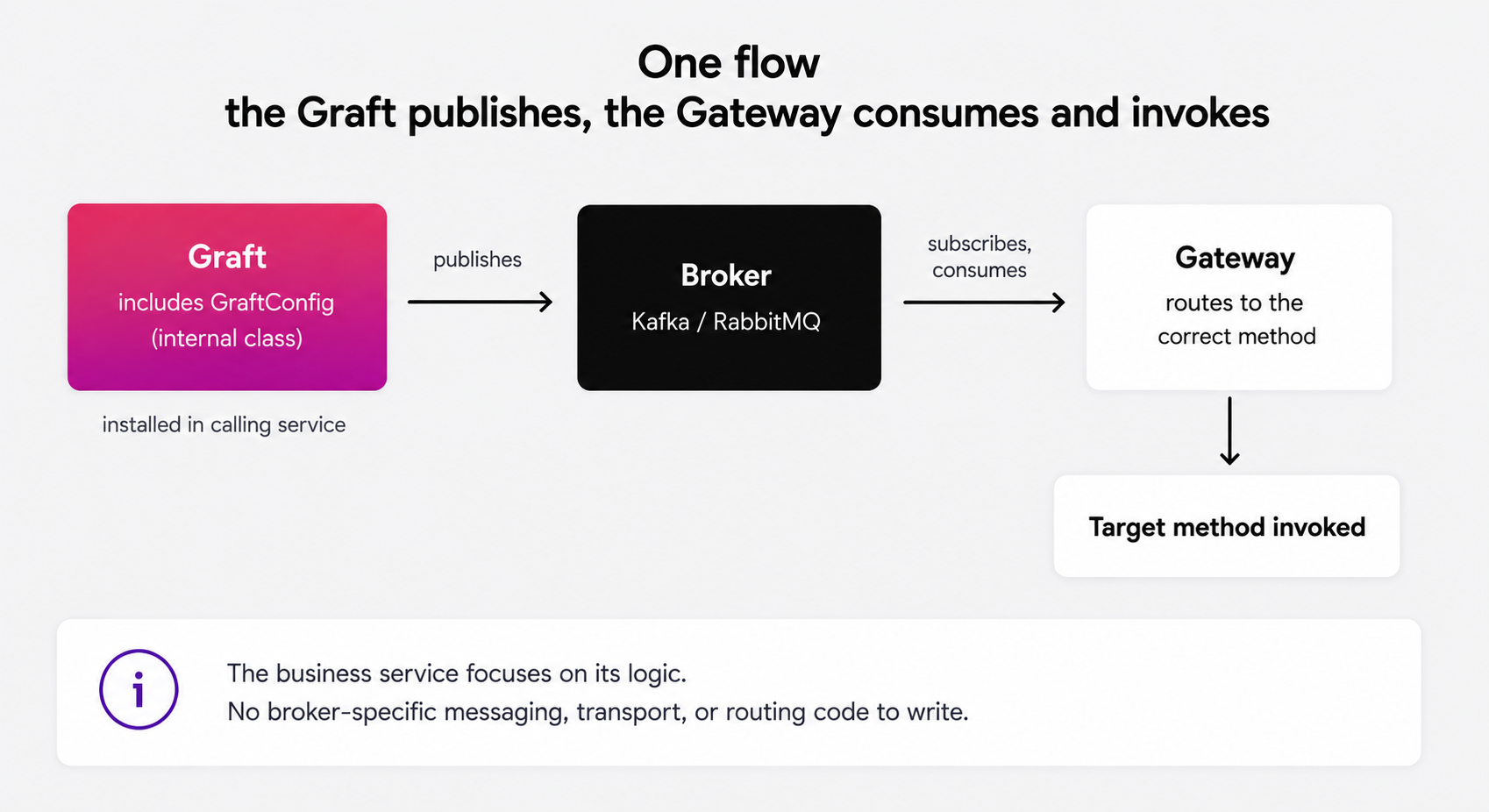
Graftcode is a cross-runtime communication layer. Services call each other's public methods through automatically generated interfaces called Grafts, installed as typed packages via standard package managers like npm, pip, NuGet, Maven, etc., without the need to hand-write integration code, DTOs, client libraries, or serialization boilerplate. The protocol underneath is Hypertube, a binary runtime bridge that connects language runtimes directly through TCP/IP, rather than wrapping HTTP.
Graftcode doesn't replace Kafka or RabbitMQ; the broker still handles the routing, fan-out, and durability it's designed for. By default, a Graft call runs over a direct connection to the target service's Gateway, entirely separate from whatever broker delivered the original message; that's the pattern shown below. Graftcode also ships an official RabbitMQ plugin that routes a Graft call through RabbitMQ instead: the Graft, using its internal GraftConfig, publishes a request to a queue, and the Graftcode Gateway, subscribed to that queue, consumes it, invokes the target method, and publishes the result back to a reply queue. That plugin is RabbitMQ-specific; this piece covers the default, direct-connection pattern in the walkthrough below.
Reduces the integration layer when you still need a broker
When Kafka or RabbitMQ is the right choice, true fan-out, event sourcing, stream processing, the broker handles routing and delivery. But after a consumer receives a message, it still needs to call downstream services to complete the work. That's where the integration tax lands.
In a typical Kafka consumer flow, a Python consumer receiving a payment event needs to call a Node.js notification service:
# Kafka consumer receives payment.completed event -- without Graftcodeconsumer = KafkaConsumer('payments', bootstrap_servers='kafka:9092')for message in consumer:payload = json.loads(message.value)order_id = payload['orderId']# Calling downstream notification service requires:# HTTP client, JSON serialization, DTO definitions,# error handling -- none of this is business logicresponse = requests.post('http://notification-service:8080/api/v1/notify',json={'orderId': order_id, 'type': 'payment_confirmed'},headers={'Content-Type': 'application/json'})result = response.json()
Every field name must match the notification service's expected schema exactly. If the Node.js team renames orderId to order\_id on its side, the request from the Python consumer either gets rejected by validation or has the field silently ignored, depending on how the notification service handles unrecognized fields, with no compile-time signal either way.
Graftcode removes the need to hand-write this. The walkthrough below uses Graftcode's default transport, a direct connection from the Graft to the target service's Gateway, independent of whichever broker delivered the original message. Three steps replace the integration layer with a typed call.
Step 1: Start the Gateway alongside the notification service
The Graftcode Gateway (gg) runs the notification service; it spins up a runtime for the configured modules and exposes their methods according to access policies the developer defines, not automatically every public method in the codebase. Developers control which assemblies, namespaces, classes, methods, files, or folders get exposed, so nothing is surfaced by default beyond what's explicitly configured. No endpoint definitions, no annotations, no protobuf files:
# On the notification service hostgg --modules ./notification-service.js
The Gateway discovers the configured modules and serves them, by default, on port 80 for calls and port 81 for Graftcode Vision, live documentation of the exposed methods.
Step 2: Install the Graft in the calling service
From the calling service, install the Graft, a strongly typed interface generated directly from the notification service's public methods. The install command is generated by Graftcode Vision at http://<notification-host>:81/GV:
npm install --registry https://grft.dev/<project-id> @graft/nuget-notificationservice@1.0.0
Graft is a real installed package, not a hand-written client. It mirrors the notification service's public interface precisely: method names, argument types, return types. IDE autocompletion works on every method.
Step 3: Configure the Graft's GraftConfig and call the method
const { GraftConfig, NotificationService } = require("@graft/nuget-notificationservice");// Point GraftConfig at the notification service's GatewayGraftConfig.host = "wss://notification-service:9000/ws";GraftConfig.stateless = true; // recommended for inter-microservice calls -- full response in one round trip// Kafka consumer loopfor await (const message of consumer) {// JSON.parse here is decoding the raw Kafka message payload -- unrelated to the Graft call belowconst { orderId } = JSON.parse(message.value);// Strongly typed remote call -- Graft responses arrive as typed objects,// no manual JSON parsing or DTOs needed on this sideawait NotificationService.sendPaymentConfirmation(orderId);}
The Kafka consumer handles event routing. Graftcode handles the downstream service call. Each layer does what it's designed for.
For local development, point GraftConfig.host at inMemory; the call runs in-process with no network hop, and no Kafka cluster or broker needs to be running locally to test the downstream service call. That removes the cost and setup time of standing up Kafka or a message broker on a developer's machine just to validate this part of the flow. Switch to the deployed Gateway address in production. The method call doesn't change either way:
// Local developmentGraftConfig.host = "inMemory";// ProductionGraftConfig.host = "wss://notification-service:9000/ws";
What Graftcode replaces:
| Without Graftcode | With Graftcode |
|---|---|
| Message consumer/producer client code and downstream service calls written per language pair | Graft installed via package manager |
| DTO classes defined on both sides | Strongly typed interface auto-generated |
| JSON serialization/deserialization | Handled by Hypertube binary protocol |
| Manual versioning coordination | Interface changes surface as package updates |
| Runtime field-name mismatches | Detected as early as the package update, and at compile time at the latest |
| Separate teardown when service retires | Remove the package install |
Reducing AI token consumption in agentic systems
AI-native microservices introduce a token cost that traditional architectures don't have. When LLMs or agents orchestrate workflows across services, they need to understand the callable surface of those services, what exists, what it accepts, and what it returns.
In a Kafka or RabbitMQ-based flow, that surface includes more than the message schema itself. An agent working across the codebase also has to read the consumer setup code, the downstream HTTP or client calls a consumer makes after processing a message, the DTOs on both ends, and the manual serialization and error-handling logic wrapped around each of those calls. None of that is business logic; it's integration scaffolding the model has to parse before it can reason about what the service actually does.
With Graftcode, that integration scaffolding is reduced. A consumer's downstream call becomes a typed method call instead of hand-written client code:
// What an agent sees with GraftcodeOrderService.getOrderById(orderId: string): Promise<Order>OrderService.updateOrderStatus(orderId: string, status: OrderStatus): Promise<void>NotificationService.sendPaymentConfirmation(orderId: string): Promise<void>
This isn't the entire interface an agent needs to reason about; type definitions, enum values, method semantics, authorization rules, and side-effect behavior still matter and still need to be understood. But the method signature is the call surface itself, without the surrounding client setup, serialization, and manual error-handling code that would otherwise sit around it.
With less non-business-logic scaffolding in the codebase, an LLM working across services has less to parse before it can focus on what the service actually does. In agentic pipelines where models read across the codebase to plan and execute workflows, this reduces the per-call context load and compounds into meaningful cost savings as the number of services and agent interactions grows.
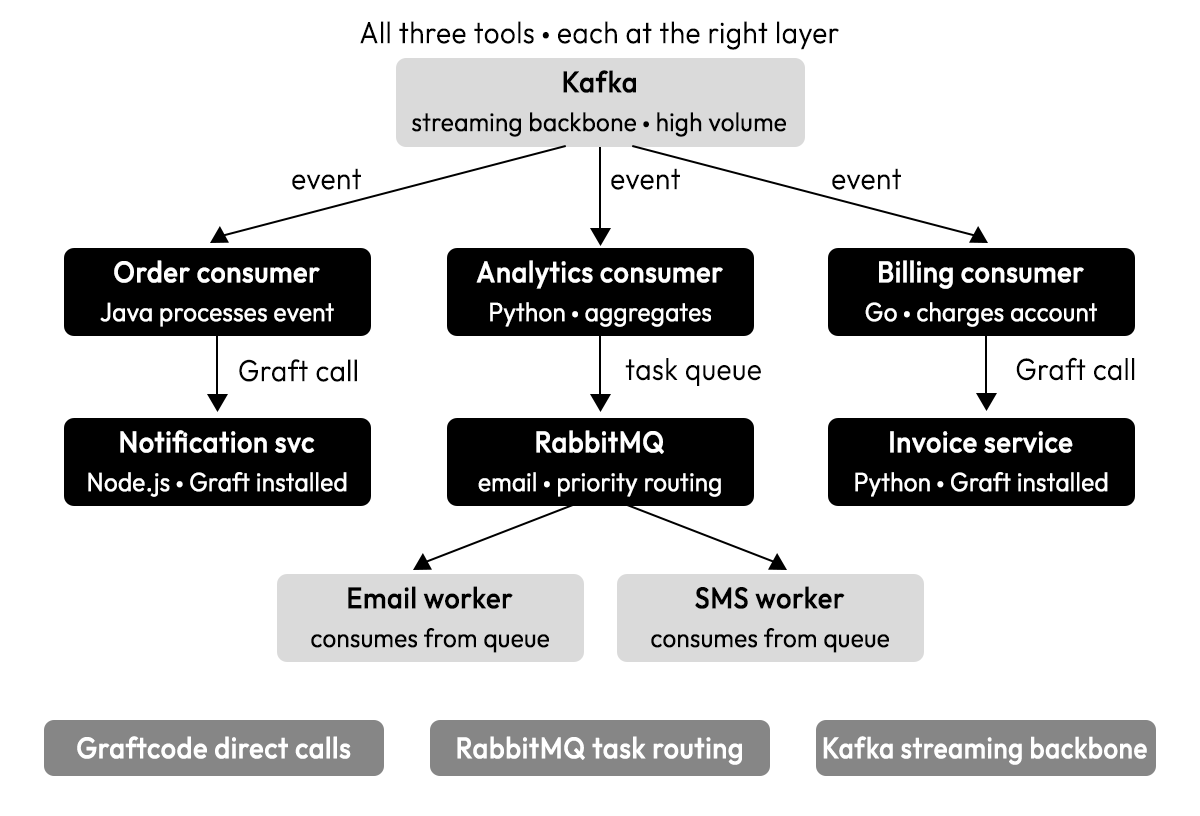
Kafka handles the streaming backbone for high-volume event pipelines; RabbitMQ handles task queuing and complex routing at the service level; and Graftcode handles the integration layer above both.
[8]When to consider alternatives to all three
Neither Kafka nor RabbitMQ nor Graftcode is the right answer for every team:
- Redis Streams: An append-only log structure with consumer groups and replay support, distinct from Redis's separate Pub/Sub feature, which has no persistence or replay. A good fit for teams already running Redis who need lightweight streaming without deploying a dedicated broker.
- AWS SNS + SQS / Google Pub/Sub: Teams on managed cloud infrastructure who don't want to operate a broker cluster
- NATS: Ultra-low latency, edge computing, IoT scenarios where NATS's lightweight footprint matters
- Direct HTTP: Still the right call for simple internal APIs where typing discipline and maintenance overhead aren't problems
[9]Conclusion: Choosing the right communication layer, not just the right broker
Kafka and RabbitMQ solve the same category of problem with different architectural bets. Kafka bets on volume, replay, and exactly-once guarantees within its supported transactional workflows, primarily consuming from Kafka and producing back to Kafka. That guarantee doesn't extend automatically to external side effects like database writes, API calls, payments, or emails; those still need to be made idempotent at the consumer level regardless of broker. RabbitMQ bets on routing flexibility, push-based delivery, and operational simplicity.
The broker decision matters, but it's one layer of a larger communication architecture. For workloads that don't need fan-out or durable message persistence, a broker introduces operational overhead for a problem that a runtime communication layer addresses more directly. And for workloads where a broker is the right call, the integration layer that sits above it, how services call each other after a message lands, is where the compounding complexity lives.
Picking the right tool at each layer is what makes a microservices architecture actually maintainable as it grows.
[10]FAQs
1. Kafka vs RabbitMQ performance: how large is the throughput gap in practice?
Kafka handles 1M+ messages per second under production loads. RabbitMQ typically peaks at 40K–100K messages per second, depending on queue configuration and message size. The gap is real but often irrelevant; most microservices workloads don't approach RabbitMQ's ceiling. The more useful performance distinction is latency: RabbitMQ's push model gets individual messages to consumers faster. Kafka's pull model is optimized for batch throughput, not per-message speed.
2. Can RabbitMQ Streams replace Apache Kafka for event sourcing workloads?
RabbitMQ Native Streams (added in 3.9) provide an append-only log with consumer offsets, which covers the basic replay use case. For straightforward event sourcing where a single cluster also handles task queues and routing, RabbitMQ Streams is a viable option. Where it falls short: Kafka's partition model gives finer-grained parallelism and throughput that Streams doesn't match. For pure high-volume event streaming, Kafka remains the stronger choice.
3. What is KRaft and how does it simplify Kafka's operational model?
KRaft (Kafka Raft) is the consensus protocol that became production-ready during Kafka's 3.x releases and fully replaced ZooKeeper with Kafka 4.0. Previously, running Kafka required operating a separate ZooKeeper cluster alongside Kafka brokers, two systems to monitor, tune, and keep in sync. KRaft moves cluster metadata management into Kafka itself using a Raft-based controller quorum. The result: fewer moving parts, faster controller failover, and a simpler operational footprint. Kafka clusters can now be managed as a single system.
4. How does Graftcode reduce AI token consumption in agentic microservices?
When an LLM orchestrates workflows across services via REST or through broker consumer code, it reads OpenAPI specs, DTO schemas, client code, error handling, and serialization logic, all as tokens; none of it is business logic. Graftcode reduces that surface to typed method signatures, cutting the integration scaffolding the model has to parse before it can reason about what a service does. Type definitions, semantics, and authorization rules still matter and still need to be understood, but the surrounding client setup and serialization code are gone. In agentic pipelines where models read across the codebase to plan execution, this reduces context per call, which compounds into meaningful cost savings as service interactions scale."
5. When should a team use Kafka, RabbitMQ, and Graftcode together in the same architecture?
In a microservices architecture, Kafka, RabbitMQ, and Graftcode operate at different layers. Kafka works well as a streaming backbone for high-volume event pipelines, payment events, user activity feeds, and sensor data ingestion. RabbitMQ handles service-level task queues and complex routing, email delivery queues, priority-based job processing, and multi-protocol integrations. Graftcode reduces the integration layer above both: the cross-service calls a consumer needs to make after a Kafka or RabbitMQ message lands, and the calls a downstream service to complete the work. Each tool operates at its own layer, so no tool is doing work it wasn't designed for.
/WRITTEN BY